
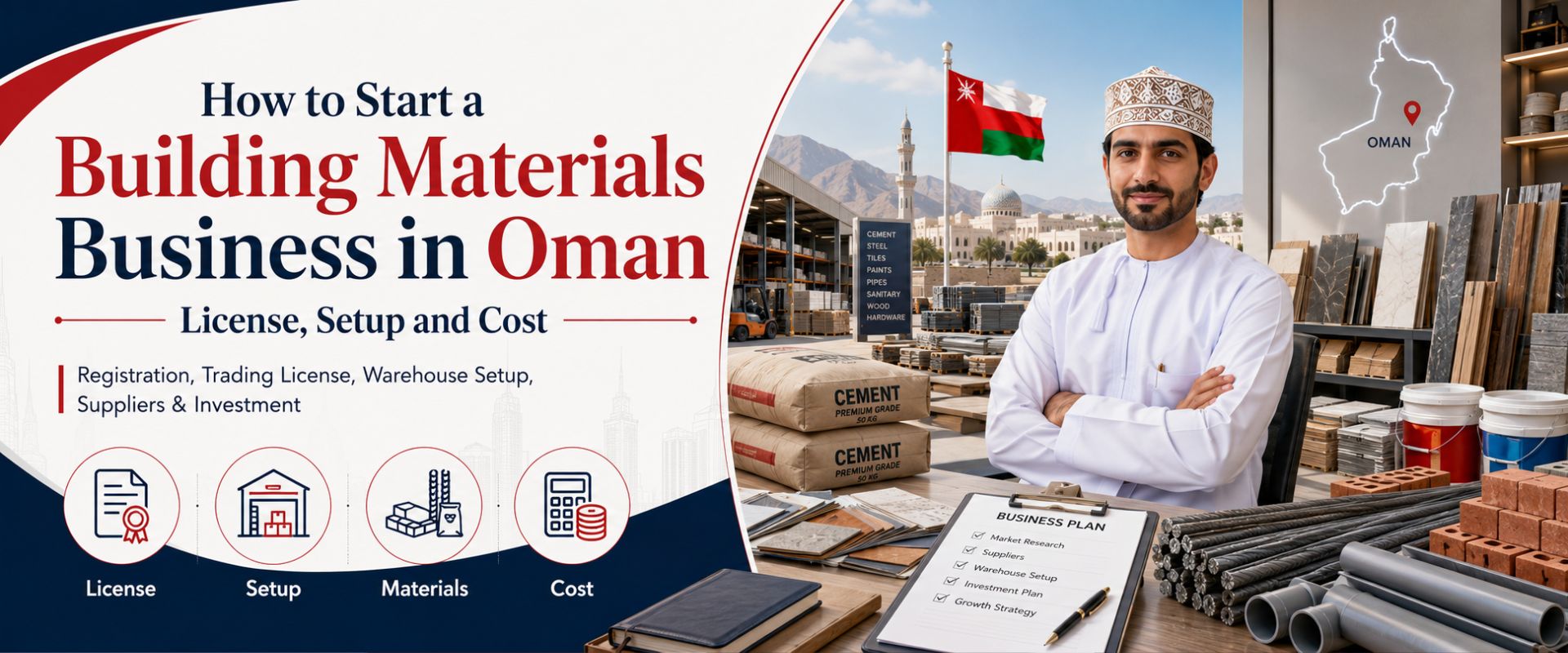

Starting a building materials business in Oman requires registering a trading company with the Ministry of Commerce, Industry and Investment Promotion (MOCIIP), obtaining a construction materials trading license, securing warehouse approvals from the relevant municipal authority, and establishing supplier and logistics arrangements before beginning commercial operations. The licensing track for a materials trading or supply company is entirely separate from that of a construction contracting company, with different activity codes, warehouse requirements, and import documentation obligations.
This guide covers the complete setup process for a construction materials trading business in Oman: the trading license requirements, warehouse and storage approvals, import rules for building materials, wholesale versus retail business models, required documents, startup costs in OMR, and how free zone and mainland structures compare for materials supply operations. For a broader overview of business setup in Oman, see our main services page.
Quick answer: A building materials trading business in Oman needs a MOCIIP trading license (distinct from a construction contracting license), a municipally-approved warehouse, and Oman Customs importer registration if sourcing directly from abroad. Total startup investment for an entry-level mainland trading operation runs OMR 78,000 to 310,000, dominated by initial stock and warehouse lease costs. Full licensing, warehouse, import, and cost details are below.
Table of Contents
Construction Materials Trading License in Oman
Every building materials trading company in Oman must hold a commercial trading license issued by MOCIIP with an activity code specific to construction or building materials supply. The license authorizes the business to buy, stock, and sell construction materials within Oman and, depending on the scope of the activity, to import materials directly from international suppliers.
The activity code assigned during company registration determines the permitted product range. Businesses that trade only in finished materials such as tiles, fixtures, and fittings register under a general trading or building materials trading activity. Companies that handle raw materials, including cement, aggregates, steel rebar, and structural steel, may require additional approvals from the Ministry of Housing and Urban Planning or the relevant municipality, depending on the specific storage and handling requirements for those materials.
A trading license differs significantly from a construction contracting license. A materials trading company supplies goods to contractors and developers. It does not carry out construction works. The two activities require separate licenses and separate company registrations. See our guide to starting a construction company in Oman for the contracting license process.
Warehouse and Storage Approvals for Building Materials in Oman
Building materials businesses in Oman that hold physical stock require a warehouse or storage facility that meets municipal safety and zoning standards. The warehouse must be located within a commercially or industrially zoned area. Residential or mixed-use plots are not permitted for the storage of commercial materials.
Municipal approval for a building materials warehouse involves a site inspection covering:
- Zoning compliance: The site must be designated for commercial or industrial use in the relevant governorate’s land use plan.
- Fire safety requirements: Storage facilities handling flammable materials or large volumes of bulk goods must comply with Civil Defence fire safety standards, including clearances, suppression systems, and emergency access.
- Weight and structural compliance: Warehouses storing heavy materials such as cement bags, steel bars, or aggregates must have floor load ratings certified by a structural engineer.
- Health and environmental approvals: Materials such as cement, coatings, adhesives, and chemical additives may require additional approvals from the Ministry of Environment and Climate Affairs for handling.
Businesses operating from Sohar, Salalah, or Duqm free zones benefit from pre-approved warehousing infrastructure with customs-bonded storage options, which simplifies both import handling and bulk storage compliance for materials traders. See our guides to Sohar Free Zone and Salalah Free Zone for zone-specific warehouse details.
Importing Construction Materials into Oman
Many building materials businesses in Oman source a significant portion of their product range through direct imports. Oman is a member of the Gulf Cooperation Council (GCC) and applies a standard 5% customs duty on most imported construction materials. Materials originating from GCC member states and meeting the rules of origin requirements enter duty-free under the GCC customs union agreement.
Import License and Customs Registration
Companies that import building materials directly must register as an importer with the Oman Customs Authority under the Ministry of Finance. Import registration is separate from the MOCIIP commercial registration and requires the company’s CR, tax registration number, and bank account details. The Oman Customs portal handles importer registration and customs declaration submissions.
Product Certification and Standards Compliance
Building materials imported into Oman must comply with Omani Standards (OS) or, where applicable, GCC technical standards. The Oman Standards, Metrology and Quality Authority (OSMOQA) enforces product standards for construction materials, including cement, steel reinforcement bars, aggregates, and insulation products. Non-compliant materials can be held at customs or returned at the importer’s cost. Certification documentation from the manufacturer, including test reports and conformity declarations, should accompany every shipment for materials subject to OSMOQA standards.
Wholesale vs Retail Building Materials Business Models
Building materials businesses in Oman operate under two distinct commercial models, each with different licensing, capital, and operational requirements.
| Factor | Wholesale and Bulk Supply | Retail Building Materials |
|---|---|---|
| Customer base | Contractors, construction companies, property developers, industrial clients | Individual builders, small contractors, residential customers |
| Order size | Bulk quantities, higher minimum order values | Smaller, more frequent purchases |
| Margins | Lower per unit, offset by transaction volume | Higher unit margins |
| Facility needs | Substantial warehouse capacity, heavy goods vehicle access | Commercial shopfront or trade counter plus storage |
| Product range | Narrower, focused on structural/bulk materials | Broader SKU range: tiles, sanitaryware, paints, hardware, finishing materials |
| Best suited to | Investors with stronger starting capital and existing industry relationships | Investors targeting diverse walk-in and small-contractor demand |
Cost to Start a Building Materials Business in Oman
Startup cost varies significantly based on whether the business operates as a wholesale importer, a retail trader, or a combination. The table below covers the main cost components for a standard entry-level mainland trading operation.
| Cost Item | Estimated Range (OMR) |
|---|---|
| MOCIIP company registration | 300 to 600 |
| LLC share capital (mainland trading) | 20,000 to 50,000 |
| Building materials trading license | 300 to 1,000 |
| Municipal warehouse or showroom license (annual) | 500 to 2,000 |
| Customs importer registration | 100 to 300 |
| Warehouse lease (annual, 500 to 1,500 sqm) | 12,000 to 45,000 |
| Initial stock purchase | 30,000 to 150,000 |
| Fleet or logistics (forklift, delivery vehicle) | 8,000 to 35,000 |
| Staff salaries (3 months) | 5,000 to 18,000 |
| Marketing and trade account setup | 2,000 to 8,000 |
| Total estimated investment | 78,000 to 310,000 |
Step-by-Step Process to Register a Building Materials Trading Company in Oman
- Register the company with MOCIIP. Submit the Memorandum of Association with a building materials trading or general trading activity code, share capital deposit certificate, shareholder identification, and office lease through the Invest Easy portal. CR is typically issued within seven to ten working days. This step can be handled through our company registration service.
- Obtain the trading license. Apply for the construction materials trading license following CR issuance. Ensure the activity code covers all product categories your business intends to trade.
- Secure the warehouse and obtain municipal approval. Sign the warehouse lease and submit the municipal business license application. A site inspection is typically required before the municipal license is issued.
- Register as an importer with Oman Customs. Complete importer registration on the Oman Customs portal if the business will import directly. This is required before the first import shipment can be processed.
- Open a corporate bank account. A corporate bank account is required for all supplier payments, customs duties, and client receipts. See our guide to opening a corporate bank account in Oman.
- Establish supplier agreements and logistics. Finalize supply agreements with local or international manufacturers and arrange inland transport for deliveries to your warehouse and outbound to clients.
Frequently Asked Questions
What license is needed to start a building materials business in Oman?
A construction materials or building materials trading license from MOCIIP is required, assigned under the Commercial Registration activity code. Companies that import directly must also register as importers with Oman Customs.
Can a foreigner start a building materials trading company in Oman?
Yes. Foreign investors can establish a mainland LLC with an Omani partner holding at least 30% shareholding, or register through a free zone for 100% ownership. Free zone structures suit import-focused and wholesale operations. Mainland LLCs have unrestricted access to all domestic clients, including government-linked contractors.
Is a warehouse required for a building materials business in Oman?
Any business holding physical stock must have a warehouse or storage facility approved by the municipality. The site must be in a commercially or industrially zoned area. Businesses operating on a drop-shipment or distribution-only model without physical stock may operate from an office, but this limits product range and client service capability.
What customs duty applies to imported building materials in Oman?
Oman applies a standard 5% GCC customs duty on most imported building materials. Materials originating from GCC member countries that meet the rules of origin requirements enter duty-free under the GCC customs union. Some specialty materials may be subject to different duty rates. Always verify applicable rates through the Oman Customs portal before finalizing supplier agreements.
What is the difference between a building materials trading company and a construction contracting company?
A building materials trading company supplies goods to contractors and developers. A construction contracting company physically carries out construction works on projects. Both require separate licenses, separate activity codes, and separate regulatory approvals. The two activities cannot be combined under a single standard commercial registration.
Conclusion
Starting a building materials business in Oman requires a construction materials trading license from MOCIIP, warehouse and municipal approvals, customs importer registration for direct imports, and compliance with Omani product standards for imported materials. Startup investment for an entry-level mainland trading operation typically ranges from OMR 78,000 to OMR 310,000, with initial stock purchases and warehouse leases as the dominant cost components.
Getting the activity code, warehouse approvals, and import documentation right from the start avoids delays and compliance issues that affect stock availability and client relationships. MakeMyCompany assists building materials entrepreneurs with every stage of setup in Oman, from MOCIIP registration and trading license applications to warehouse approval coordination, customs registration, and bank account opening. Contact our team at omanbusinesssetup.com to discuss your requirements for setting up a building materials business.
About the Author
Shuja Ahmad is a Business Setup Consultant at MakeMyCompany, a business formation consultancy based in Muttrah, Muscat, Oman. He specialises in business setup in Oman across all trading and industrial sectors, including the registration of building materials trading companies, applications for construction materials trading licenses, coordination of warehouse approvals, customs importer registrations, and corporate bank account openings. Shuja advises entrepreneurs and foreign investors on the most efficient and compliant route to establishing a building materials supply or wholesale business in Oman. For expert guidance on setting up a construction materials business in Oman, visit Oman Business setup.