
Tax & Accounting
Internal Audit vs External Audit in Oman: Roles, Differences and Legal Requirements
By Shuja AhmadLast reviewed 16 July 2026Free first consultation · reply within one business day
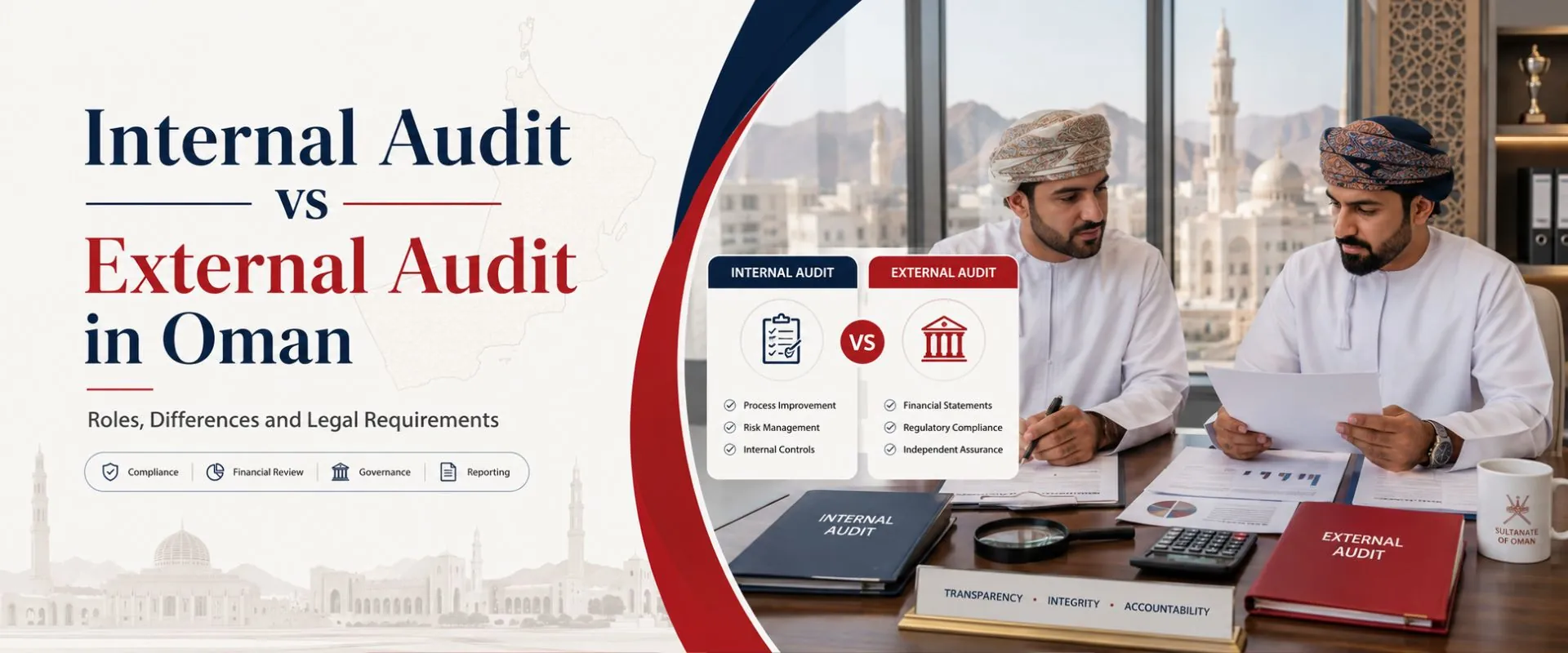
Businesses use internal and external audits to protect financial integrity, improve operational efficiency, and support regulatory compliance. While both types of audits are important, they have different purposes, reporting lines, scopes, and legal implications.
This guide explains internal audit responsibilities, external audit procedures, the difference between internal and external audit, and the circumstances in which an Oman business may need one or both. Businesses preparing their records for review may also benefit from professional accounting and bookkeeping services in Oman.
Quick Answer: Internal audit examines an organisation’s risks, controls, governance, and operational processes for management and the board. External audit independently examines financial statements and issues an auditor’s opinion. In Oman, external audit requirements depend on the company’s legal form, capital, number of shareholders, Constitutive Documents, and applicable sector regulations.
Internal Audit Roles and Objectives Explained
The internal audit function focuses on risk assessment, internal control evaluation, governance, and organisational improvement. It helps management identify weaknesses before they result in financial loss, non-compliance, fraud, or operational disruption.
Risk Management and Control Evaluation
Internal audit teams analyse financial, operational, compliance, technology, and fraud risks. They assess whether internal controls, policies, approvals, and reporting systems are properly designed and consistently followed.
For example, an internal auditor may review how payments are approved, how inventory is controlled, whether employees have inappropriate access to financial systems, or whether important duties are divided between different team members.
Operational Efficiency and Process Improvement
Internal reviews can identify unnecessary steps, duplicated work, weak approval systems, and avoidable costs. Recommendations may be made to improve workflows, reporting quality, resource use, and overall operational performance.
Internal audit is therefore not limited to accounting records. It may also review procurement, payroll, inventory, information technology, contract management, compliance procedures, and business continuity.
Compliance Monitoring and Governance Support
Internal auditors check whether the organisation follows internal policies, contractual obligations, governance frameworks, and applicable regulations.
Their findings help senior management and the board understand where controls are working and where corrective action is required. This can also help the organisation prepare for regulatory reviews or an external financial statement audit.
External Audit Responsibilities and Objectives
External audit responsibilities focus mainly on providing an independent opinion on a company’s financial statements.
An external auditor is independent of the company’s management and must be appropriately licensed or authorised to conduct statutory audit work.
Validation of Financial Statements
External auditors examine financial statements, accounting records, supporting documents, estimates, and selected transactions. Their objective is to determine whether the financial statements are prepared fairly and in accordance with the applicable financial reporting framework.
Businesses preparing for an audit should maintain complete ledgers, bank reconciliations, invoices, payroll records, asset schedules, and supporting documents. Our guide on how to prepare financial statements explains the main statements and records involved.
Independence and Assurance for Stakeholders
External auditor independence gives greater credibility to financial information. The auditor’s report may be used by shareholders, investors, lenders, regulators, business partners, and other authorised stakeholders.
The external auditor does not manage the company or design its daily procedures. The auditor independently evaluates the financial information and supporting evidence.
Regulatory and Statutory Compliance
An external audit may be required because of:
- The company’s legal form
- The number of shareholders
- The amount of share capital
- Provisions in its Constitutive Documents
- A shareholder request
- A lender or investor requirement
- A sector regulator
- A contractual obligation
- A proposed transaction or funding round
The exact external audit requirement should therefore be checked against the company’s structure and current Oman regulations rather than assumed to apply equally to every business.
Internal Audit vs External Audit: Key Differences
Understanding the difference between internal and external audit helps a business choose the right type of review and avoid confusing operational assurance with statutory financial assurance.
| Comparison Area | Internal Audit | External Audit |
|---|---|---|
| Main purpose | Improve controls, risk management, governance, and operations | Provide an independent opinion on financial statements |
| Primary users | Management, board, and audit committee | Shareholders, owners, regulators, lenders, and other authorised stakeholders |
| Scope | Financial, operational, compliance, technology, governance, and fraud risks | Financial statements and related financial reporting controls |
| Frequency | Continuous, quarterly, periodic, or risk-based | Commonly annual or linked to a specific reporting period |
| Who performs it | Employees or an outsourced internal audit team | An independent and appropriately licensed external auditor |
| Independence | Independent from the activity being reviewed, but part of or appointed by the organisation | Independent from the company and its management |
| Reporting line | Senior management, audit committee, or board | Shareholders or the body responsible for appointing the auditor |
| Main output | Internal findings, risk ratings, recommendations, and action plans | Formal auditor’s report and audit opinion |
| Legal requirement | Depends on the entity, regulator, governance framework, and internal policy | Depends on legal form, thresholds, Constitutive Documents, shareholder requests, and regulations |
| Professional standards | Global Internal Audit Standards | International Standards on Auditing and applicable Oman requirements |
Purpose, Scope, and Frequency
Internal audits are generally broader and more frequent. They can cover operations, internal controls, technology, procurement, payroll, fraud risk, governance, and compliance.
External audits are normally conducted for a defined financial period and focus mainly on whether the financial statements are fairly presented.
Reporting Lines and Independence
Internal auditors typically report functionally to the audit committee or board and administratively to senior management. This structure helps protect their objectivity while allowing access to operational information.
External auditors are appointed independently and report their audit opinion to the shareholders or other appointing body. Their independence from management is a core requirement.
Regulatory versus Managerial Focus
Internal audit mainly supports better management, stronger governance, and early risk detection.
External audit provides independent assurance over financial statements and may satisfy legal, regulatory, investor, lender, or contractual requirements.
Which Audit Does an Oman Business Need?
When comparing audit services in Oman, a business should first identify why the review is needed.
A Small or Owner-Managed Business
A small business may begin with strong bookkeeping, bank reconciliation, documented approvals, and periodic internal control reviews.
Even when an external audit is not legally required, an internal audit or independent control review can help identify cash-flow weaknesses, unauthorised transactions, poor recordkeeping, and tax compliance risks.
An LLC Meeting a Statutory Condition
An Oman LLC may need an external auditor when one of the legal conditions under the Commercial Companies Law applies. These conditions are explained in detail in the Oman-specific section below.
The company should maintain audit-ready accounting records throughout the year rather than attempting to organise all documents after the financial year has ended.
A Joint Stock or Regulated Company
Joint stock companies and businesses operating in regulated sectors generally face stronger audit, financial reporting, governance, and oversight requirements.
These organisations often benefit from both functions. Internal audit monitors risks and controls throughout the year, while external audit provides an independent opinion on the annual financial statements.
For further information on this structure, read our guide to establishing a joint stock company in Oman.
A Business Seeking Investment or Finance
A lender, investor, buyer, or potential business partner may request audited financial statements even when the company does not meet a statutory audit trigger.
Internal audit findings can also show that the business has mature controls, reliable reporting, and a structured approach to risk management.
Audit Standards: Internal vs External
Both internal and external auditors follow professional standards, but the applicable frameworks and objectives are different.
Internal Audit Standards
Internal auditors follow the Global Internal Audit Standards issued by The Institute of Internal Auditors.
These standards focus on:
- Independence and objectivity
- Risk-based planning
- Governance and oversight
- Internal control assessment
- Professional competence
- Communication of findings
- Follow-up on agreed actions
- Quality assurance
The current Global Internal Audit Standards replaced the older International Standards for the Professional Practice of Internal Auditing terminology.
External Audit Standards
External financial statement audits are conducted under applicable International Standards on Auditing and local regulatory requirements.
ISA 700 covers the auditor’s responsibility to form an opinion on financial statements and the form and content of the auditor’s report.
The external audit process normally includes risk assessment, audit planning, testing, evaluation of accounting estimates, review of evidence, and formation of an independent audit opinion.
Benefits of Internal and External Audits for Businesses
Regular audit activity can bring both compliance and commercial value.
Enhanced Controls and Risk Reduction
Internal audits can identify control gaps before they cause a material loss or regulatory problem.
External audit testing provides an independent review of financial reporting. Together, the two functions can reduce financial, operational, compliance, and fraud risks.
Credibility with Regulators, Investors, and Lenders
Audited financial statements can improve the credibility of financial information presented to shareholders, lenders, investors, regulators, and business partners.
Internal audit reports can also demonstrate that management is actively monitoring risks and resolving control weaknesses.
Strategic Improvements and Cost Savings
Internal audit recommendations may lead to better processes, clearer responsibilities, stronger approvals, and reduced operating costs.
External audit observations may also highlight accounting weaknesses, documentation gaps, or financial reporting issues that management should address.
Better Tax and Financial Compliance
Accurate accounting records support both audit readiness and tax compliance. Businesses that maintain organised books are better placed to prepare financial statements, respond to information requests, and complete tax filings.
Companies requiring support with corporate tax, VAT, or ongoing filing obligations can review our taxation services in Oman.
Audit Reporting Roles: Internal vs External
Clear reporting allows management, shareholders, and boards to understand audit findings and take appropriate action.
Internal Audit Reporting Process
Internal audit reports commonly include:
- The area reviewed
- The audit objective and scope
- Risks identified
- Control weaknesses
- Evidence supporting the finding
- Risk rating or priority level
- Recommended action
- Management response
- Responsible person
- Target completion date
Draft findings may first be discussed with the relevant department. The final report is then issued to management, the audit committee, or the board. Agreed actions should be tracked until completion.
External Audit Opinion and Auditor’s Report
External auditors issue a formal report on the financial statements.
The opinion may be:
- Unmodified opinion: The financial statements are presented fairly in all material respects.
- Qualified opinion: A specific material issue exists, but it is not pervasive across the financial statements.
- Adverse opinion: Material and pervasive misstatements mean the financial statements are not presented fairly.
- Disclaimer of opinion: The auditor could not obtain enough appropriate evidence to form an opinion.
The auditor may also communicate control weaknesses and other matters to management or those responsible for governance.
Internal Audit vs External Audit in Oman
Internal and external audits have different applications under Oman’s legal and regulatory framework.
External Audit Requirements for an LLC in Oman
The Oman Commercial Companies Law under Royal Decree 18/2019 does not impose exactly the same external audit condition on every LLC.
Under Article 278, an LLC must appoint an auditor for one financial year when any of the following applies:
- The company has more than seven shareholders.
- The company’s share capital exceeds OMR 50,000.
- The Constitutive Documents require the appointment of an auditor.
- One or more shareholders representing at least one fifth of the company’s share capital request an auditor.
An external audit may also be required by a regulator, lender, investor, contract, or another applicable legal requirement.
Businesses should confirm their position based on their company structure, registered activity, Constitutive Documents, and current regulatory requirements.
External Audit Requirements for Joint Stock Companies
Joint stock companies are subject to more formal financial reporting, auditor appointment, shareholder reporting, and governance requirements.
The applicable provisions require auditors to be licensed to practise audit and accounting. The appointment and fees are normally approved through the annual ordinary general meeting.
Internal Audit Application in Oman
Internal audit is commonly used by larger organisations, joint stock companies, regulated businesses, government-related entities, and companies with complex operations.
Private SMEs may also appoint an internal auditor or outsource internal audit services in Oman when they need stronger oversight of:
- Cash and payments
- Procurement
- Payroll
- Inventory
- Related-party transactions
- Technology access
- Regulatory compliance
- Fraud risk
- Branch or project operations
Internal audit requirements can vary depending on the entity, regulator, ownership structure, and governance framework.
Practical Application for Omani Businesses
An Oman business can use internal audit to identify control weaknesses before its external audit begins.
The business should maintain:
- Complete accounting records
- Supporting invoices and contracts
- Bank reconciliations
- Payroll records
- Asset registers
- Inventory records
- Tax filings
- Shareholder resolutions
- Updated corporate records
- Evidence that earlier findings were resolved
Businesses should also understand their wider obligations under the Oman Commercial Companies Law, particularly where audit requirements interact with financial statements, shareholder meetings, company records, and governance.
Integration Between Internal and External Audits
Internal audit and external audit should remain separate, but their work can be coordinated.
External auditors may consider relevant internal audit work after evaluating its quality, objectivity, competence, and documentation. ISA 610 provides guidance on the external auditor’s use of internal audit work.
The external auditor still remains responsible for the external audit opinion.
Good coordination may:
- Reduce unnecessary duplication
- Improve access to records
- Highlight known risk areas
- Support better audit planning
- Help management resolve control weaknesses earlier
Implementation Best Practices for Internal and External Audit Programs
Businesses can improve audit quality by planning both functions carefully.
Risk-Based Planning and Coordination
The internal audit plan should focus on the areas with the highest financial, operational, compliance, and fraud risks.
Where both audit functions exist, their schedules can be coordinated to avoid repeatedly requesting the same information from staff. However, the independence and responsibilities of the external auditor must remain unchanged.
Clear Communication and Remediation Tracking
Maintain a central record of:
- Audit findings
- Management responses
- Responsible employees
- Agreed completion dates
- Supporting evidence
- Follow-up results
- Open and closed actions
Unresolved high-risk findings should be reported to senior management and the board or audit committee.
Staff Training and Governance Awareness
Employees should understand the company’s financial controls, documentation requirements, approval levels, and audit responsibilities.
Training helps reduce incomplete records, unauthorised transactions, late responses, and repeated control failures.
Maintain Audit-Ready Accounting and Corporate Records
Audit preparation should be an ongoing process rather than a year-end exercise.
Monthly bookkeeping, reconciliations, document filing, tax records, and management reporting should be kept current. Corporate documents such as shareholder resolutions, ownership records, meeting minutes, and appointment records should also be maintained properly.
Our guide on maintaining corporate records in Oman explains the key company documents that should remain organised and accessible.
Businesses that are newly registering or restructuring can also review the requirements for company registration in Oman to ensure that their legal structure and compliance responsibilities are correctly planned from the beginning.
Conclusion
Internal audit and external audit have distinct but complementary roles.
Internal audit helps an organisation improve operations, governance, internal controls, risk management, and compliance. External audit provides an independent opinion on the company’s financial statements and may be required by law, regulators, shareholders, lenders, investors, or contractual arrangements.
For an Oman business, the correct approach depends on its legal form, share capital, number of shareholders, Constitutive Documents, regulatory sector, and commercial requirements.
Businesses should not assume that internal audit can replace a legally required external audit. They should also not view external audit as a substitute for strong day-to-day controls.
Maintaining accurate books, complete financial records, documented approvals, and organised corporate records allows both functions to work more effectively.
Our team supports Oman businesses with accounting records, financial statement preparation, tax compliance, company registration, and audit-readiness coordination. Where a statutory audit opinion is required, the audit must be completed by an appropriately licensed and independent auditor.
Related guides
Frequently asked questions
What is the main difference between internal audit and external audit?
Internal audit focuses on improving internal controls, risk management, governance, compliance, and operational performance. External audit independently examines financial statements and issues a formal audit opinion.
Is internal audit legally required for every company in Oman?
No. Internal audit is not automatically required for every private business. The requirement depends on the company’s legal form, regulatory sector, governance framework, ownership structure, and applicable rules.
When is an external auditor required for an LLC in Oman?
Under Article 278 of the Oman Commercial Companies Law, an LLC must appoint an auditor when it has more than seven shareholders, share capital above OMR 50,000, its Constitutive Documents require an auditor, or shareholders representing at least 20% of the capital request one. Other regulatory or contractual requirements may also apply.
How often should internal audits be conducted?
The frequency should be based on risk. High-risk areas may be reviewed quarterly or more frequently, while lower-risk areas may be reviewed annually or according to a multi-year audit plan.
Can external auditors use internal audit work?
Yes. External auditors may consider internal audit work after evaluating the internal audit function’s objectivity, competence, methods, and documentation. The external auditor remains responsible for the external audit opinion.
Who do internal auditors report to?
Internal auditors commonly report functionally to the audit committee or board and administratively to senior management. The reporting structure should protect their independence and access to information.
What are common internal audit findings?
Common findings include weak approval controls, incomplete documentation, unreconciled accounts, poor separation of duties, inadequate access controls, unrecorded risks, unresolved previous findings, and non-compliance with company policies.
Can a business rely only on internal audit?
A business may use internal audit alone when no law, regulation, shareholder provision, financing arrangement, or contract requires an external audit. Internal audit cannot replace a legally required external audit.
How long does an external audit take?
The timeframe depends on company size, transaction volume, record quality, number of locations, accounting complexity, and how quickly management provides documents. Organised and reconciled records usually support a smoother audit.
How do internal audit findings affect an external audit?
Well-documented internal audit findings can help an external auditor understand known risks and control weaknesses. However, unresolved or serious findings may lead to additional external audit testing.
Next steps
Related services and guides
- 01Accounting & BookkeepingOutsourced accounting and bookkeeping in Oman: IFRS accounts, monthly bookkeeping, payroll entries, management reports, audit coordination and tax-ready records.
- 02Corporate TaxCorporate income tax in Oman explained, and how we help: 15% and 3% rates, tax registration, annual returns, withholding tax, deadlines and penalties.
- 03VAT Registration in OmanComplete guide to VAT registration in Oman. Mandatory threshold OMR 38,500, documents required, OTA portal steps, VAT certificate, and penalties for…
- 04How to Open a Corporate Bank Account in OmanOpen a corporate bank account in Oman: eligible companies, KYC documents, bank choices, minimum balances, timelines and tips to avoid delays.
- 05How to Open a Business Bank Account in OmanComplete guide to opening a corporate bank account in Oman. Documents required, minimum deposits, best banks for foreign companies, KYC process and why…
- 06Audit Firm License in OmanLearn how to get an audit firm license in Oman through the FSA, including eligibility, documents, OMR 50 approval fee, application steps and renewal…
1.0
Planning a company in Oman?
Tell us your activity, shareholders and visa needs. We’ll recommend a structure and location, then send a written, itemised quote. The first consultation is free.