
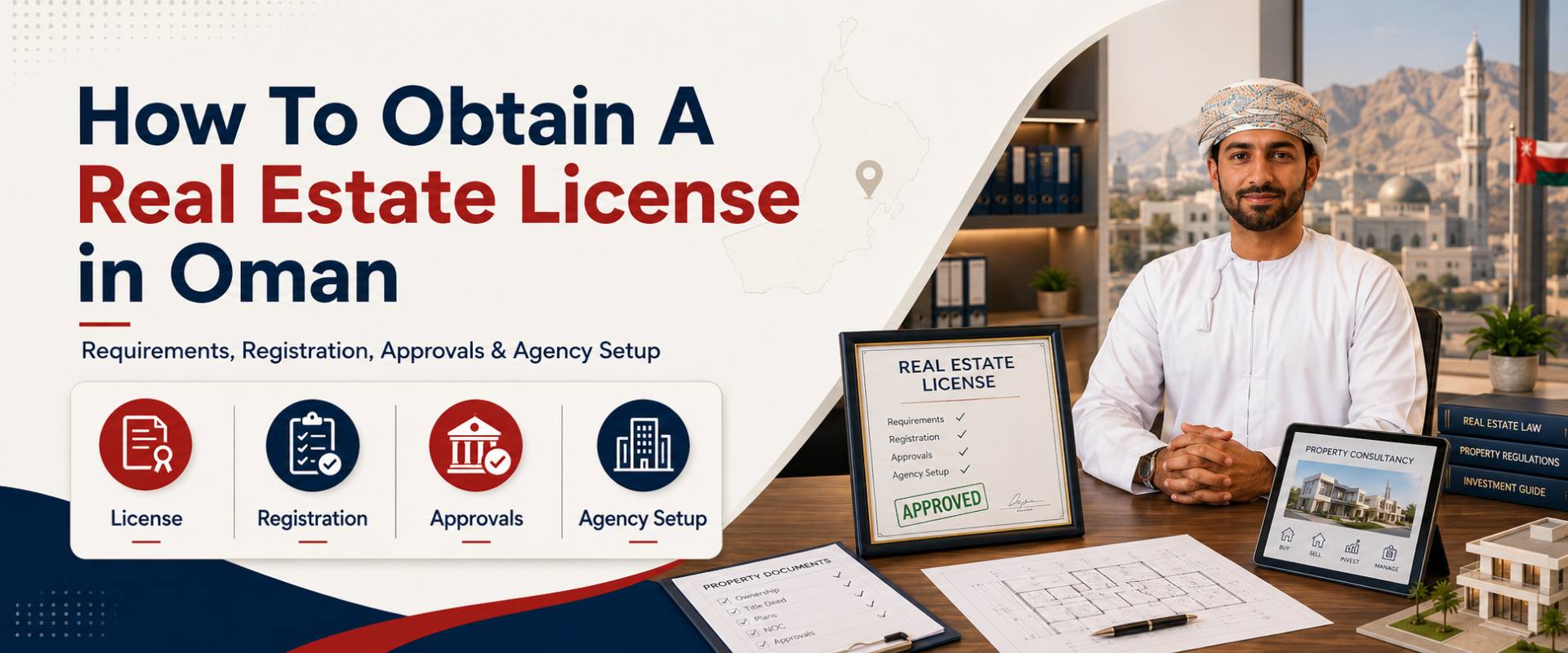

Oman’s dynamic real estate sector, driven by economic diversification, infrastructure development, and growing property investment, presents substantial opportunities for entrepreneurs seeking to establish real estate businesses. The Sultanate’s Vision 2040 development agenda emphasizes tourism, logistics, and residential development, creating sustained demand for professional real estate services. From property brokerage and sales to property management and real estate development, the sector offers diverse business possibilities for qualified professionals willing to navigate proper licensing requirements.
This comprehensive guide provides detailed information about obtaining a real estate license in Oman, covering regulatory frameworks, license types, application procedures, costs, and essential requirements to help entrepreneurs successfully establish property businesses in this expanding market.
Table of Contents
Understanding Oman’s Real Estate Licensing Framework
Oman has established comprehensive regulations governing real estate activities ensuring professional standards, consumer protection, and market integrity. All individuals and companies providing real estate services must obtain proper licensing from designated authorities demonstrating qualifications, financial capability, and commitment to professional conduct.
Regulatory Evolution and Modernization
The Omani government has modernized real estate regulations in recent years introducing clearer licensing frameworks, professional standards, consumer protection mechanisms, technology integration, and market transparency initiatives. These reforms aim to professionalize the sector, attract quality operators, protect buyers and investors, and enhance Oman’s attractiveness as a real estate investment destination. Understanding current regulations is essential for compliance and successful market entry.
Scope of Real Estate Activities
Real estate licensing in Oman covers diverse activities including property sales and brokerage connecting buyers and sellers, property leasing and rental management, Property Management License in Oman for managing buildings and developments, real estate consultancy and advisory services, property valuation and appraisal, Real Estate Development Business including project development and construction, real estate investment and fund management, and property marketing and promotion services. Each activity category has specific licensing requirements and operational standards.
Benefits of Professional Licensing
Obtaining proper real estate licensing provides legal authorization to conduct property business, credibility with clients and investors, access to official property databases and platforms, participation in industry associations and networks, eligibility for government real estate projects, protection through professional indemnity insurance, and competitive advantages in increasingly regulated markets. Licensed professionals position themselves for sustainable success in Oman’s evolving real estate sector.
Types of Real Estate Licenses in Oman
Oman’s real estate licensing framework accommodates different business models and service specializations within the property sector.
Real Estate Brokerage License
Real estate brokers facilitate property transactions between buyers and sellers or landlords and tenants. Brokerage licenses authorize marketing properties for sale or rent, conducting property viewings and negotiations, preparing sales and rental agreements, facilitating transaction documentation, providing market information and advice, and earning commissions on successful transactions. Brokers must demonstrate professional qualifications, market knowledge, ethical standards, and financial stability. This license suits professionals with sales expertise and client relationship capabilities.
Property Management License
Property Management License in Oman authorizes comprehensive management of residential, commercial, or mixed-use properties. Services include tenant acquisition and lease management, rent collection and payment processing, property maintenance and repairs coordination, facility management and utilities oversight, financial reporting to property owners, tenant relations and complaint resolution, and contract management with service providers. Property managers require operational capabilities, technical knowledge, financial management skills, and customer service excellence. This license suits professionals offering ongoing property operations services.
Real Estate Development License
Real estate developers undertake comprehensive property development projects from land acquisition through construction and sales. Development licenses authorize identifying and acquiring development land, obtaining planning and building permits, managing construction and contractor relationships, marketing and selling developed properties, coordinating financing and investment arrangements, and delivering completed projects to buyers. Property developers in Oman require substantial financial resources, technical expertise, project management capabilities, and regulatory compliance knowledge. This license suits experienced professionals or companies with significant capital and development expertise.
Real Estate Consultancy License
Real estate consultants provide professional advisory services including market research and feasibility studies, investment analysis and due diligence, property valuation and appraisal, portfolio optimization and strategy, transaction structuring and negotiation support, and regulatory compliance guidance. Consultancy licenses require demonstrating professional qualifications, industry experience, analytical capabilities, and technical expertise. This license suits experienced professionals offering specialized knowledge and advisory services.
Real Estate Marketing License
Marketing specialists focus on promoting properties through advertising campaigns, digital marketing and social media, property photography and videography, virtual tours and multimedia content, lead generation and client acquisition, and brand development for real estate projects. Marketing licenses suit professionals with creative capabilities, digital expertise, and promotional skills supporting property sales and leasing.
Steps to Obtain Real Estate License in Oman
Obtaining a real estate license requires systematic progression through qualification verification, business registration, and licensing procedures.
Verify Professional Qualifications
Assess whether you meet eligibility requirements for real estate licensing. Requirements typically include relevant educational qualifications (bachelor’s degree in business, marketing, real estate, or related fields preferred), minimum professional experience in real estate sector (often 2-5 years depending on license type), clean legal record without criminal convictions, financial capability meeting minimum capital requirements, Omani citizenship or legal residency status, and professional certifications if available. Gather documentation evidencing your qualifications before proceeding with applications.
Complete Required Training Programs
The Ministry of Housing and Urban Planning may require completion of approved real estate professional training programs covering property laws and regulations, ethical standards and professional conduct, contract preparation and documentation, market analysis and valuation methods, customer service and communication, and technology systems for property management. Complete mandatory training programs obtaining certificates required for licensing applications.
Choose Your Business Structure
Determine whether you will operate as an individual real estate professional or establish a real estate company. Options include individual practitioner license for sole professionals, Limited Liability Company (LLC) for corporate real estate businesses, partnership structures for multiple practitioners, or branch office for international real estate companies. Business structures involve different capital requirements, ownership regulations, and operational implications. Consider your investment capacity, growth plans, and operational preferences when selecting structure.
Register Business with MoCIIP
If establishing a company, register with the Ministry of Commerce, Industry and Investment Promotion by submitting business information and shareholder details, proposed real estate activities, business name reservation, capital deposit proof, and registration fees. MoCIIP issues Commercial Registration certificate establishing your legal business entity. Individual practitioners may skip this step if operating as sole practitioners without company formation.
Prepare Comprehensive Documentation
Compile complete documentation supporting your real estate license application including educational certificates and degrees, professional experience letters from previous employers, curriculum vitae detailing real estate career, training program completion certificates, passport and identification documents, bank reference letters confirming financial standing, proof of capital availability meeting requirements, business plan outlining real estate services and operations, office location documentation, insurance policy proposals, and character reference letters from professionals. Thorough documentation demonstrates qualifications and preparedness.
Submit License Application to Ministry of Housing and Urban Planning
Apply for real estate license through the Ministry of Housing and Urban Planning submitting completed application forms, all required documentation, commercial registration certificate if company, proof of office location, insurance documentation, professional qualification evidence, and applicable licensing fees. The Ministry reviews applications verifying qualification completeness, assessing professional competency, evaluating financial capability, checking background and legal standing, and confirming operational preparedness.
Undergo Interview and Assessment
The Ministry of Housing and Urban Planning may conduct interviews or assessments evaluating your understanding of real estate regulations and laws, knowledge of market conditions and practices, awareness of ethical standards and consumer rights, communication and professional presentation skills, and commitment to professional conduct. Prepare thoroughly demonstrating comprehensive knowledge and professionalism.
Secure Office Location
Real estate businesses require proper office facilities meeting regulatory standards. Lease commercial office space in appropriate locations, ensure office meets professional standards and accessibility requirements, obtain municipality approvals for commercial operations, install necessary technology and communication systems, and display required licenses and certifications. Professional office presence enhances credibility and client confidence.
Obtain Professional Indemnity Insurance
Secure comprehensive professional indemnity insurance covering liability for professional advice and errors, protection for clients against negligence or misconduct, coverage meeting minimum regulatory requirements, and policy from approved insurance providers. Provide proof of adequate insurance coverage to the Ministry of Housing and Urban Planning as required for licensing.
Receive Real Estate License
Upon satisfactory completion of all requirements, the Ministry of Housing and Urban Planning issues your real estate license authorizing specific property services. The license specifies authorized activities, license holder details, validity period (typically annual), operational conditions and restrictions, and professional obligations. Display your license prominently at your office as required by regulations.
Complete Post-Licensing Requirements
After receiving your license, complete additional steps including registering with Oman Chamber of Commerce and Industry, opening a corporate bank account for business transactions, establishing professional website and marketing presence, joining real estate professional networks, implementing property management software systems, and developing client acquisition and service delivery procedures.
Cost To Obtain A Real Estate License in Oman
Understanding comprehensive cost structures enables proper financial planning for real estate business establishment.
Licensing and Registration Fees
Commercial registration with MoCIIP for real estate companies costs approximately OMR 200-500 depending on structure and capital. Real estate license application fees with the Ministry of Housing and Urban Planning range from OMR 300-1,000 depending on license type and scope. Professional training program costs range from OMR 200-800 per course. Oman Chamber of Commerce and Industry registration adds approximately OMR 100-200 annually. Municipality approvals cost around OMR 50-200.
Office and Operational Setup Costs
Office space rental varies by location from OMR 300-1,200 monthly depending on size, area, and facilities. Office furniture and equipment require OMR 2,000-8,000. Computer systems and software cost OMR 1,500-5,000. Professional signage and branding materials require OMR 500-2,000. Website development and digital presence costs OMR 800-3,000. Property management software subscriptions range from OMR 50-200 monthly.
Insurance and Professional Costs
Professional indemnity insurance for real estate professionals costs OMR 300-1,500 annually depending on coverage scope and activities. General liability insurance adds OMR 200-800 annually. Office contents insurance requires OMR 150-500 annually. Legal consultation for contract templates and compliance guidance costs OMR 300-1,000. Accounting services for bookkeeping and tax compliance range from OMR 100-300 monthly.
Marketing and Business Development Costs
Initial marketing including brochures, business cards, and promotional materials costs OMR 500-2,000. Online advertising and digital marketing budgets range from OMR 200-1,000 monthly. Property listing platform subscriptions cost OMR 50-300 monthly. Networking events and professional development require OMR 100-500 quarterly. Brand development and positioning investments range from OMR 1,000-5,000.
Capital Requirements
Individual practitioner licenses may require demonstrating access to minimum capital of OMR 1,000-5,000. Real estate brokerage companies typically need a minimum capital of OMR 5,000-20,000. Property management companies require OMR 10,000-30,000 minimum capital. Real estate development companies need substantially higher capital ranging from OMR 50,000-500,000+ depending on development scale and ambitions.
Total Investment Estimates
Individual real estate practitioners typically require total initial investments of OMR 3,000-10,000 covering licensing, basic office setup, and initial operations. Small real estate brokerage companies generally need OMR 10,000-30,000. Property management companies require OMR 20,000-60,000. Real estate development companies need OMR 100,000-1,000,000+ depending on project scope and scale. These estimates include licensing, office setup, equipment, insurance, marketing, and working capital.
Essential Documentation Requirements
Comprehensive documentation supports your real estate license application demonstrating qualifications and preparedness.
Complete Document Checklist
- Valid passport with minimum six months validity
- Omani residence permit for expatriate applicants
- Educational certificates including bachelor’s degree or equivalent qualifications
- Professional experience certificates from previous real estate employers
- Detailed curriculum vitae outlining complete real estate career history
- Training program completion certificates from approved real estate courses
- Character reference letters from professional contacts or community leaders
- Bank reference letters confirming financial standing and banking relationships
- Proof of capital availability meeting minimum requirements for license type
- Commercial Registration certificate from MoCIIP for company applications
- Memorandum of Association for corporate real estate businesses
- Business plan outlining services, target market, and operational approach
- Office lease agreement or property ownership documentation
- Municipality approval for office location and commercial operations
- Professional indemnity insurance policy meeting coverage requirements
- General liability insurance covering business operations
- Passport-size photographs meeting Omani government specifications
- No Objection Certificate from current employer if employed in Oman
- Police clearance certificate demonstrating clean legal record
- Professional association memberships if applicable to credentials
- Technology and systems documentation showing operational capabilities
- Marketing materials and website information demonstrating professional presentation
Compliance and Professional Standards
Maintaining real estate license status requires ongoing compliance with regulations and professional conduct standards.
Annual License Renewal
Real estate licenses require annual renewal with the Ministry of Housing and Urban Planning. Submit renewal applications 30-60 days before expiry, provide updated documentation including insurance renewals, demonstrate continued business activity, pay renewal fees, and complete any required continuing education. Timely renewals prevent operational disruptions and maintain legal status.
Continuing Professional Development
Real estate professionals must maintain current knowledge through ongoing education including regulatory updates and law changes, market trends and analysis, technology and digital tools, professional ethics and conduct, and customer service excellence. Participate in training programs, workshops, and industry conferences demonstrating commitment to professional growth.
Ethical Standards and Conduct
Licensed real estate professionals must adhere to ethical standards including honest and transparent client communications, fair treatment of all parties, disclosure of conflicts of interest, protection of client confidential information, accurate property representations and marketing, and compliance with advertising regulations. Ethical violations can result in license suspension, fines, or permanent revocation.
Consumer Protection Obligations
Real estate businesses must protect consumer rights through clear contract terms and documentation, proper handling of client funds and deposits, timely communication and responsiveness, accurate property information and disclosures, fair negotiation practices, and accessible complaint resolution procedures. Consumer protection prioritizes client welfare and market integrity.
Strategic Considerations for Real Estate Success
Beyond licensing, strategic approaches and professional excellence determine success in Oman’s competitive real estate market.
Specialization and Niche Focus
Consider specializing in specific property segments including luxury residential properties, commercial office and retail spaces, industrial and logistics properties, tourism and hospitality real estate, affordable housing and residential communities, or land and development opportunities. Specialization enables developing deep expertise, building targeted networks, commanding premium fees, and differentiating from generalist competitors.
Technology Integration
Leverage technology enhancing operations and client service through property management software, virtual property tours and 3D visualization, customer relationship management systems, digital marketing and social media, online property portals and listings, and data analytics for market insights. Technology adoption improves efficiency and client experiences.
Relationship Building and Networking
Success in real estate depends heavily on relationships. Develop networks with property developers in Oman, financial institutions and mortgage providers, legal professionals and notaries, contractors and property maintenance providers, other real estate professionals, and potential clients and investors. Strong relationships drive referrals and business opportunities.
Market Knowledge and Research
Maintain current understanding of property market trends and pricing, regulatory changes and development plans, economic indicators affecting real estate, demographic shifts and demand patterns, and competitive activities and market positioning. Market expertise enables providing valuable insights and advice differentiating your services.
How Make My Company Supports Your Real Estate License Application
Navigating Oman’s real estate licensing procedures, meeting qualification requirements, and ensuring comprehensive compliance requires specialized expertise and established relationships with regulatory authorities. Make My Company provides end-to-end support as experienced Company Setup Consultants in Oman specifically assisting entrepreneurs to Start Real Estate Business in Oman.
Our experienced team guides you through every phase from initial qualification assessment through operational launch. We handle eligibility verification and qualification guidance, real estate training program enrollment assistance, business structure recommendations optimizing your setup, commercial registration with Ministry of Commerce, Industry and Investment Promotion, comprehensive documentation preparation and organization, real estate license applications with Ministry of Housing and Urban Planning, office location identification and lease negotiations, municipality approvals coordination, professional indemnity insurance arrangement, technology and systems setup guidance, and ongoing compliance support ensuring adherence to real estate regulations.
Make My Company maintains established relationships with the Ministry of Housing and Urban Planning, Ministry of Commerce, Industry and Investment Promotion, Oman Chamber of Commerce and Industry, municipalities, and relevant authorities throughout Oman. Our expertise ensures efficient application processing, full compliance with professional and regulatory standards, transparent cost structures, and timely license issuance enabling rapid business commencement.
We understand the unique challenges and opportunities in Oman’s real estate sector including qualification requirements, capital considerations, competitive market dynamics, technology integration needs, and professional development pathways. Whether you’re an experienced real estate professional seeking to establish independent practice, an entrepreneur entering the property business, or an international company expanding into Oman’s market, Make My Company delivers customized solutions matching your specific experience level, service focus, and business objectives.
Beyond initial establishment, we provide ongoing support including annual license renewals with timely reminders, business expansion consulting for additional services or locations, compliance management ensuring continued regulatory adherence, professional development guidance, and strategic advisory services helping optimize operations and capture growth opportunities in Oman’s dynamic and expanding real estate sector.
Contact us today to schedule a consultation and discover how Make My Company can streamline your real estate license application process, coordinate with all relevant authorities, and enable you to focus on building a successful property business while we handle the regulatory complexities and administrative requirements of establishing your real estate operations in Oman’s promising property market.