

Information based on Oman Commercial Companies Law, MOCIIP company registration procedures, Gov.om service guidance, Oman Tax Authority rules, and practical business setup experience in Muscat.
Oman has made company registration more accessible for entrepreneurs, consultants, freelancers, and investors who want to start a business with a clear legal structure. One of the simplest structures for a solo owner is a Single Person Company, commonly known as an SPC.
An SPC company in Oman allows one person or one legal entity to own the full share capital while keeping the business legally separate from the owner. This makes it useful for founders who want ownership control, limited liability protection, and a registered company that can open a bank account, sign contracts, apply for licences, and move toward tax and visa compliance.
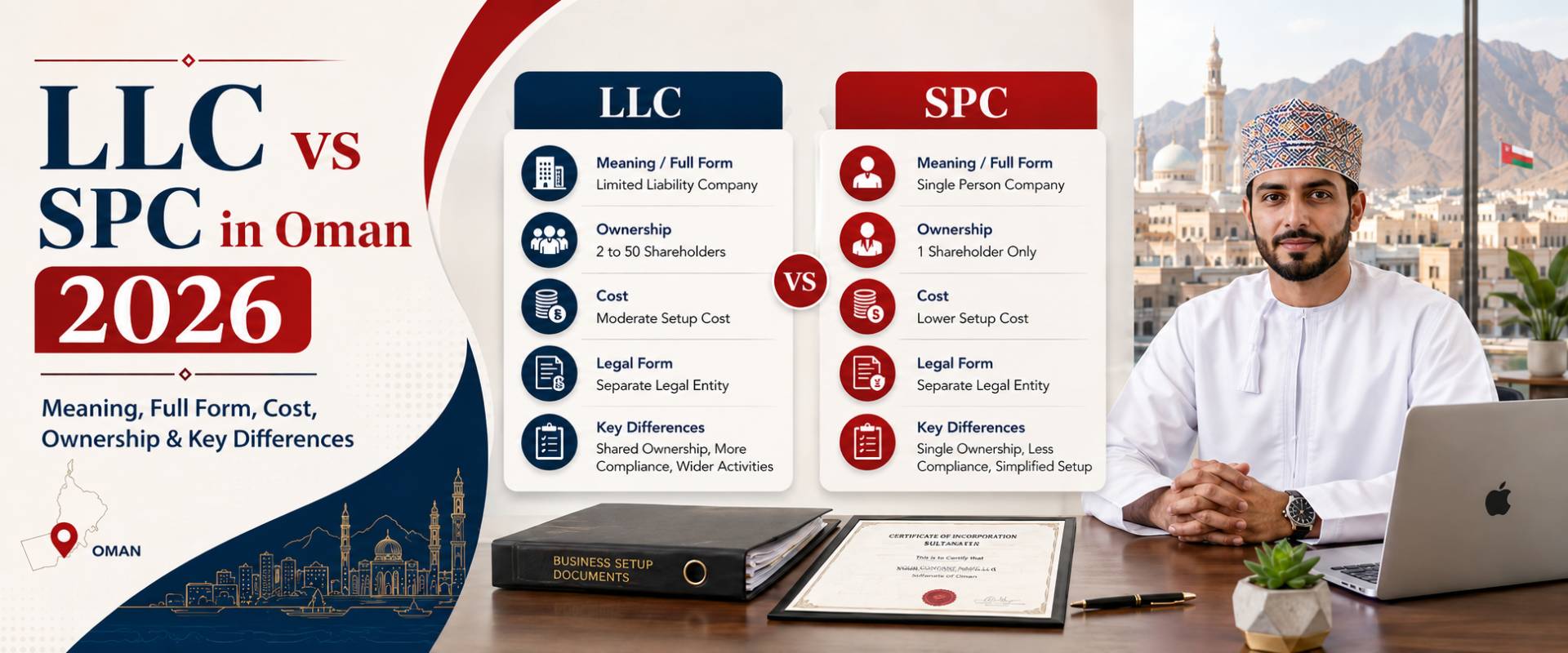
If you are still comparing structures, read our guide on LLC vs SPC in Oman. If you already want professional help with filing, visit our company registration in Oman service page.
Table of Contents
Quick Facts: SPC Registration in Oman 2026
| Item | Details |
|---|---|
| SPC full form | Single Person Company |
| Legal meaning | One-person limited liability company |
| Best for | Solo founders, consultants, freelancers, small business owners, independent professionals |
| Owner type | One natural person or one legal entity |
| Main authority | Ministry of Commerce, Industry and Investment Promotion |
| Digital filing route | Oman Business Platform / MOCIIP self-service channels; older users may still refer to Invest Easy |
| Official service | Apply for Commercial Registration for One-Person Company |
| Required company document | Articles of incorporation for a one-person company |
| Important rule | A natural person cannot establish more than one one-person company |
| VAT rate | 5% |
| VAT mandatory threshold | OMR 38,500 taxable supplies |
| Corporate tax | 15% standard rate, or 3% for qualifying small enterprises under specific conditions |
| Investor visa fee | Gov.om lists OMR 250 for 5 years and OMR 500 for 10 years, subject to eligibility |
What is a Single Person Company in Oman?
A Single Person Company in Oman is a company owned by one person or one legal entity. Under Oman’s Commercial Companies Law, a one-person company is treated as a limited liability company whose share capital is wholly owned by one natural or juristic person.
This is different from a traditional sole proprietorship. A sole proprietorship usually gives the owner less separation between personal and business liability, while an SPC creates a separate corporate identity when registered correctly.
In practical terms, an SPC can:
- operate under its own Commercial Registration
- sign contracts in the company name
- open a corporate bank account
- apply for business licences
- register for tax and VAT where applicable
- sponsor visas where eligibility conditions are met
- protect the owner’s personal assets within the limits of the law
Important: limited liability protection works only when the owner keeps company affairs separate from personal affairs. If the owner acts in bad faith, liquidates the company improperly, or does not separate company business from personal business, liability protection can be affected.
For wider legal context, read our Oman Commercial Companies Law guide.
Who Can Register an SPC in Oman?
SPC registration may be suitable for:
- Omani citizens
- GCC nationals
- foreign investors where the activity and ownership route qualify
- individual entrepreneurs
- consultants and professional service providers
- solo business owners
- one legal entity that wants to own a separate company
Foreign investors should avoid assuming that every activity can be registered as an SPC without review. Oman allows foreign ownership in many approved activities, but the final route depends on the business activity, sector rules, documents, and whether an investment licence or special approval is required.
Some activities may require additional approval from MOCIIP or sector-specific authorities such as the Ministry of Health, Ministry of Education, Financial Services Authority, Municipality, or other regulators.
For detailed ownership guidance, read our foreign ownership rules and legal structures in Oman guide.
Key Benefits of an SPC in 2026
Complete Ownership Control
An SPC allows one owner to control the company. There are no partners or shareholders involved in daily decisions. This is useful for solo entrepreneurs, freelancers, consultants, designers, IT professionals, marketing specialists, e-commerce founders, and independent service providers.
Limited Liability Protection
An SPC is legally separate from the owner. This means the company’s liability is generally limited to the company’s capital and assets, provided the owner follows proper legal and financial separation.
Simpler Management
Because there is only one owner, decision-making is easier. There is no need to manage shareholder disputes, partner approvals, or multi-owner voting unless the company is converted into another structure later.
Suitable for Small and Solo Businesses
SPC registration is often practical for businesses that do not need partners at the beginning. If your business later grows and you need shareholders, investors, or partners, you may need to review whether conversion to an LLC is more suitable.
For a dedicated LLC route, visit our LLC company registration in Oman page.
Easier Compliance Compared to Multi-Shareholder Structures
SPCs can be easier to manage than multi-shareholder companies because there is only one owner. However, the company still needs proper records, tax registration, renewals, accounting, and licensing compliance.
For post-registration support, see our corporate secretarial services in Oman and accounting and bookkeeping services in Oman.
Business Activities Permitted for SPCs
The activities available for an SPC depend on MOCIIP classification, ownership eligibility, and sector approval requirements.
Common activity categories that may be suitable for SPC registration include:
- business consulting
- management advisory
- IT services
- software development
- digital marketing
- e-commerce
- design services
- content creation
- training and education support, where approved
- professional services, where permitted
- import and export activities, subject to additional requirements
- event management
- small service-based businesses
Regulated or restricted activities may need special approvals or may be more suitable under another structure. These can include activities related to healthcare, education, financial services, insurance, engineering, construction, petroleum, telecommunications, and other regulated sectors.
If your plan involves selling online, read our e-commerce license Oman guide before choosing the activity.
Step-by-Step SPC Registration Process for 2026
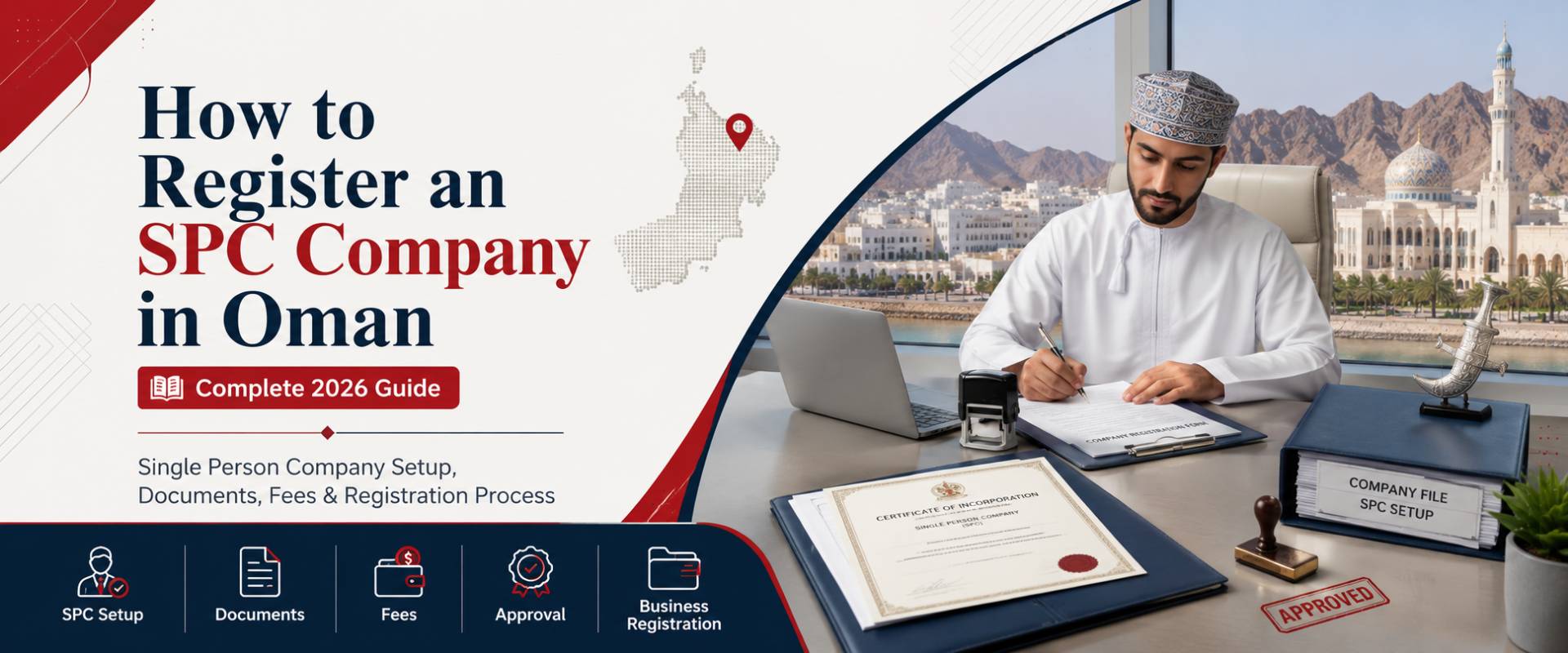
SPC company registration in Oman is usually completed through MOCIIP’s digital business channels. The process may look simple, but the correct sequence matters because your business activity affects approval, licensing, tax, banking, and visa steps.
Step 1: Select Your Business Activity
Start by choosing the correct commercial activity. This is one of the most important steps because it decides:
- whether SPC is suitable
- whether foreign ownership is possible
- whether sector approval is required
- whether municipality licensing is needed
- whether a physical office is required
- whether future visa approvals may be affected
Many registration delays happen because the activity selected does not match the actual business model.
Step 2: Reserve Your Trade Name
After activity selection, reserve the trade name. The name should match the business activity and should not mislead users, authorities, banks, or customers.
A strong trade name should be:
- unique
- relevant to the activity
- compliant with naming rules
- easy to use in contracts and invoices
- suitable for future branding
If you need help with naming, read our business name registration in Oman guide.
Step 3: Prepare the Articles of Incorporation
For a one-person company, the official company document is usually the articles of incorporation or constitutive document. This document identifies the company, owner, activity, capital, management, and legal structure.
Foreign documents may require attestation, translation, or verification depending on the document type and country of issue.
Step 4: Submit Required Documents
The exact document list depends on your case, but common documents may include:
- passport or civil ID copy
- proposed trade name
- selected business activity
- owner details
- articles of incorporation
- address or lease details
- photograph, where required
- no-objection certificate, where applicable
- attested foreign documents, where applicable
- sector approval documents, where applicable
If a legal entity owns the SPC, additional corporate documents may be needed.
Step 5: Submit the Commercial Registration Application
The commercial registration application is submitted through the relevant MOCIIP / Oman Business Platform route or through approved service offices.
Gov.om’s one-person company service page lists the service as “Apply for Commercial Registration for One-Person Company” and explains that the service enables applicants to request a commercial register for a one-person company through self-service or service offices.
Step 6: Pay Government Fees
Official fees depend on the application and activity. Gov.om currently shows:
- Administrative fee: OMR 8
- New commercial register fee: OMR 40
Additional costs may apply depending on activity, licensing, office, municipality approval, OCCI membership, consultant support, attestation, and post-registration requirements.
Step 7: Receive the Commercial Registration
Once approved, the company receives its Commercial Registration. Your CR is the legal identity of the company and is required for many next steps, including licensing, tax registration, bank account opening, and visa planning.
To understand CR details, read our company registration number in Oman guide.
Step 8: Complete Post-Registration Requirements
After CR issuance, your company may still need:
- Oman Chamber of Commerce and Industry steps, where applicable
- municipality licence
- tax registration
- VAT registration if the threshold applies
- corporate bank account opening
- accounting records setup
- investor visa or employee visa planning
- activity-specific permits
This is why “CR issued” does not always mean the company is fully ready to operate.
For full registration support, visit our company registration in Oman service page.
Complete Cost Breakdown for 2026
SPC registration cost in Oman depends on whether you are calculating only the official CR service cost or the full practical setup cost.
Official Registration Layer
| Cost Item | Estimated / Official Guidance |
| Administrative fee | OMR 8 shown on Gov.om service page |
| New commercial register fee | OMR 40 shown on Gov.om service page |
| Activity-related fee | May vary |
| Municipality / licence fee | Activity and location dependent |
| OCCI / chamber steps | May apply depending on activity and registration type |
Practical Setup Cost
In real business setup, the total cost may also include:
- trade name support
- document preparation
- articles of incorporation drafting
- translation or attestation
- office or flex desk
- municipality licence
- sector approvals
- tax registration support
- bank KYC file preparation
- investor visa or employee visa support
- accounting setup
- professional service fee
Estimated Practical Cost Range
| Setup Type | Practical Estimate |
| Basic SPC registration support | OMR 450–850+ professional support, depending on scope |
| Standard SPC setup with office/licensing support | OMR 1,000–2,500+ depending on activity and location |
| SPC with visa, office, banking, and compliance setup | Cost depends on visa route, lease, bank, documents, and approvals |
Important: Avoid comparing only one advertised government fee with full-service setup packages. One source may describe only CR filing, while another includes office, visa, bank, tax, and professional support.
For a broader breakdown, read our company registration cost in Oman guide.
Tax Obligations for SPCs in 2026
After SPC registration, tax compliance should be planned early.
Corporate Income Tax
Oman’s standard corporate tax rate is 15% of net taxable income. Small enterprises may qualify for a reduced 3% tax rate if they meet the required conditions.
Common SME conditions include:
- registered capital does not exceed OMR 60,000
- annual gross income does not exceed OMR 150,000
- average number of employees does not exceed 25
- the activity is not excluded from SME tax treatment
Do not assume every SPC automatically qualifies for the 3% rate. The company must meet the conditions.
Tax Registration
The Oman Tax Authority requires income tax registration for establishments engaged in economic activity within 60 days from the date of starting activity or from registration with MOCIIP.
VAT Registration
Oman applies 5% VAT on most taxable goods and services. VAT registration becomes mandatory when annual taxable supplies reach or are expected to reach OMR 38,500.
Voluntary VAT registration may be available from OMR 19,250.
For tax compliance support, visit our taxation services in Oman page.
Official reference: Oman Tax Authority Registration
Official reference: Oman Tax Authority Tax Rates
Official reference: Gov.om VAT Registration
Investor Visa and Residence After SPC Registration
Foreign SPC owners may need investor visa or residency support after company registration. This depends on eligibility, investment route, company documents, and authority approval.
Gov.om lists investor visa fees as:
- OMR 250 for 5 years
- OMR 500 for 10 years
The applicant must meet investment conditions, and the application is linked to the Ministry of Commerce, Industry and Investment Promotion route.
Visa eligibility should be reviewed separately from company registration. Having a company does not automatically guarantee every visa approval.
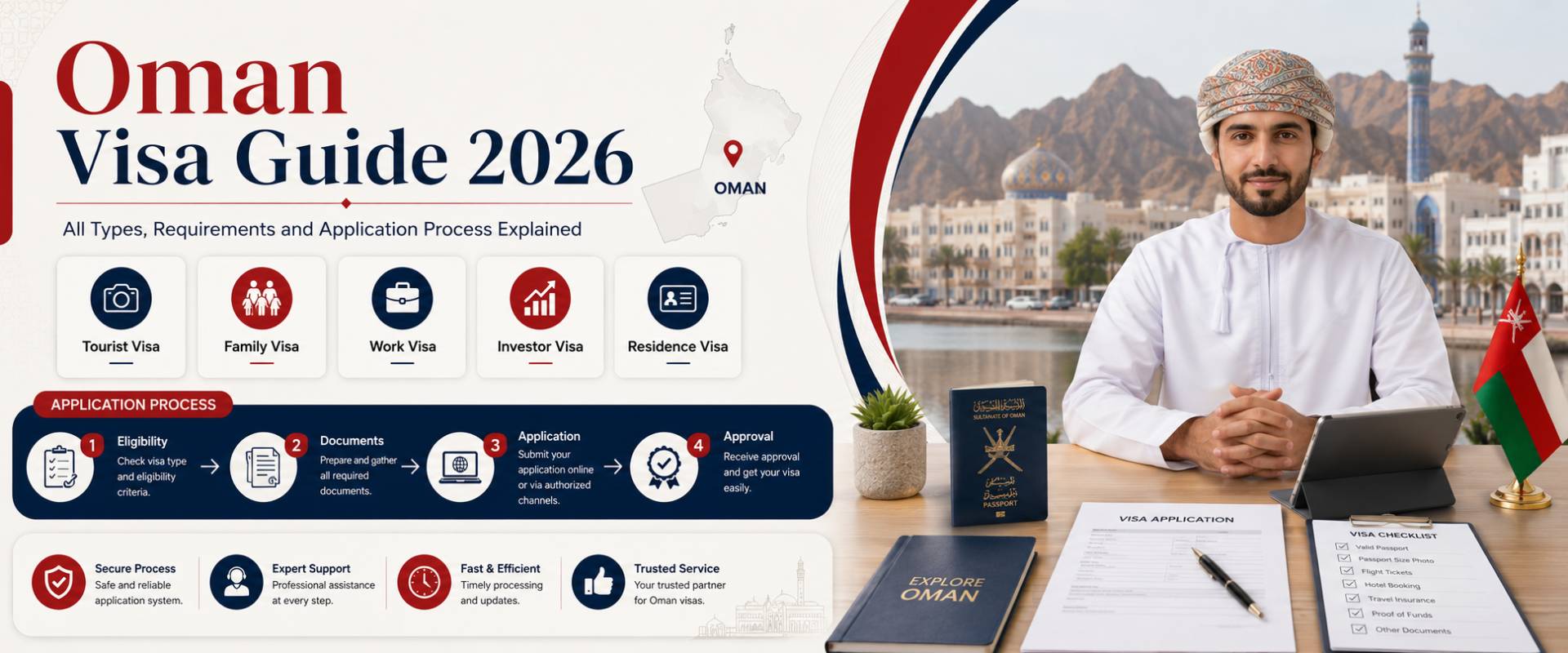
For support, visit our visa services in Oman page.
Official reference: Gov.om Investor Visa
What to Check Before Registering an SPC in 2026
Instead of relying on general “new reform” claims, focus on what actually affects your application.
Before submitting an SPC registration application, check:
- whether your business activity is permitted for an SPC
- whether foreign ownership is allowed for the activity
- whether additional sector approval is required
- whether a lease or physical office is needed
- whether the business needs municipality approval
- whether tax registration must be completed immediately after setup
- whether VAT may apply based on projected revenue
- whether your bank will accept the activity and documents
- whether investor or employee visa planning is realistic
This approach helps avoid delays after the CR is issued.
Office Space Requirements in 2026
Most companies in Oman need a valid business address. The exact office requirement depends on activity, location, municipality rules, bank expectations, and licensing requirements.
Common office options include:
- traditional office lease
- flex desk or co-working address, where accepted
- free zone office, if registering in a free zone
- activity-specific premises, where required by the regulator
Virtual offices may be accepted only for limited activities and should not be assumed for every SPC. Some banks and authorities may still expect stronger address proof or lease documentation.
SPC vs LLC in Oman: Which One Should You Choose?
An SPC is usually better if:
- you are the only owner
- you want full control
- you do not need partners
- your activity is simple
- you want easier internal management
- you want a company structure separate from personal liability
An LLC is usually better if:
- you have partners
- you want investors
- you need shared ownership
- you want a structure with 2 to 50 shareholders
- your business will grow through shareholder participation
- your activity is better suited to a multi-shareholder structure
For a full comparison, read LLC vs SPC in Oman.
Common Mistakes to Avoid During SPC Registration
Avoid these mistakes:
- choosing the wrong business activity
- assuming every foreigner can register every activity as SPC
- using unsupported cost estimates
- ignoring municipality licence requirements
- not preparing attested documents correctly
- treating CR issuance as the final step
- delaying tax registration
- ignoring VAT threshold planning
- choosing SPC when LLC is better for future partners
- mixing personal and business transactions after registration
Proper planning saves time, reduces amendment costs, and improves your chances of smooth banking, licensing, and tax compliance.
Conclusion
Registering an SPC company in Oman can be a practical route for solo entrepreneurs, consultants, freelancers, and investors who want one-owner control with limited liability protection.
The key is to choose the correct activity, confirm ownership eligibility, prepare the right documents, follow the correct MOCIIP / Oman Business Platform process, and complete post-registration steps such as tax, VAT, banking, office, licensing, and visa planning.
If your business will remain one-owner, an SPC may be suitable. If you plan to add partners, raise investment, or operate through a larger shareholder structure, an LLC may be more practical.
MakeMyCompany helps business owners review the right structure, prepare documents, submit applications, and complete post-registration steps in Oman.
Speak With a Company Registration Consultant
Frequently Asked Questions
What is the full form of SPC company?
SPC stands for Single Person Company. In Oman, it refers to a one-person company structure where one natural person or one legal entity owns the company.
What is an SPC company in Oman?
An SPC company in Oman is a one-person limited liability company. It allows one owner to control the company while keeping the business legally separate from the owner.
Is an SPC the same as a sole proprietorship in Oman?
No. An SPC is a separate legal entity with limited liability protection. A sole proprietorship does not usually provide the same level of corporate separation.
Can a foreigner register an SPC in Oman?
A foreigner may be able to register an SPC in Oman if the business activity, ownership route, documents, and approval requirements qualify. This should be checked before filing the application.
Do I need an Omani partner for an SPC?
Not always. Many activities may allow foreign ownership, but this depends on activity classification and current foreign investment rules. Some restricted or regulated activities may require special approval or another structure.
Can one person own more than one SPC in Oman?
A natural person cannot establish more than one one-person company under Oman’s company law.
How much does it cost to register an SPC in Oman?
Gov.om shows an OMR 8 administrative fee and OMR 40 new commercial register fee for the one-person company CR service. The full practical setup cost can be higher because office, licensing, documents, tax, visa, banking, and professional support may apply.
How long does SPC registration take in Oman?
The official service page shows the one-person company service through the government channel, but the real timeline depends on document readiness, activity approval, sector requirements, payment, and post-registration steps. Standard cases are usually faster than regulated activities.
What documents are required for SPC registration in Oman?
Common documents include passport or ID, trade name details, business activity, owner details, articles of incorporation, address or lease details, and any NOC, attestation, translation, or sector approval where applicable.
Can I open a bank account under an SPC?
Yes. Once the SPC is registered, you can apply for a corporate bank account. Banks may request CR documents, ownership documents, activity details, address proof, source of funds, and business plan information.
Can I hire employees under an SPC?
Yes, an SPC may hire employees if the company is properly registered and meets labour, visa, and Omanisation requirements. Approval depends on activity, company status, quota, and Ministry of Labour / ROP procedures.
Can an SPC be converted into an LLC later?
Yes, restructuring may be possible if the business grows and you want to add shareholders. The process requires proper documentation, approvals, and updates to the company records.
What is the minimum capital requirement for SPC in Oman?
For many standard activities, the capital requirement is activity-dependent rather than a single fixed amount. However, the stated capital should still make sense for the business activity, banking, licensing, and visa needs. Regulated sectors may have separate requirements.
Do I need to register for VAT?
VAT registration is mandatory if annual taxable supplies reach or are expected to reach OMR 38,500. Voluntary registration may be available from OMR 19,250.
What government authorities are involved in SPC registration?
The main authority is the Ministry of Commerce, Industry and Investment Promotion. Depending on the activity, other authorities may include Oman Tax Authority, Royal Oman Police, Ministry of Labour, Oman Chamber of Commerce and Industry, Municipality, and sector-specific regulators.
Legal Disclaimer
This guide is for general information only and is based on publicly available Oman business registration, company law, tax, VAT, and visa guidance available at the time of review. Requirements may change based on activity, nationality, ownership route, location, authority updates, and sector regulations. Always verify current requirements through official Oman government channels or an experienced business setup consultant before filing.
About the Author
Shuja Ahmad is an Oman business setup consultant specializing in company formation, SPC registration, LLC setup, Commercial Registration, and post-registration compliance. He helps entrepreneurs and investors understand MOCIIP procedures, activity selection, ownership routes, and practical setup requirements in Oman.
For professional assistance with SPC registration in Oman, visit MakeMyCompany’s company registration in Oman service.