
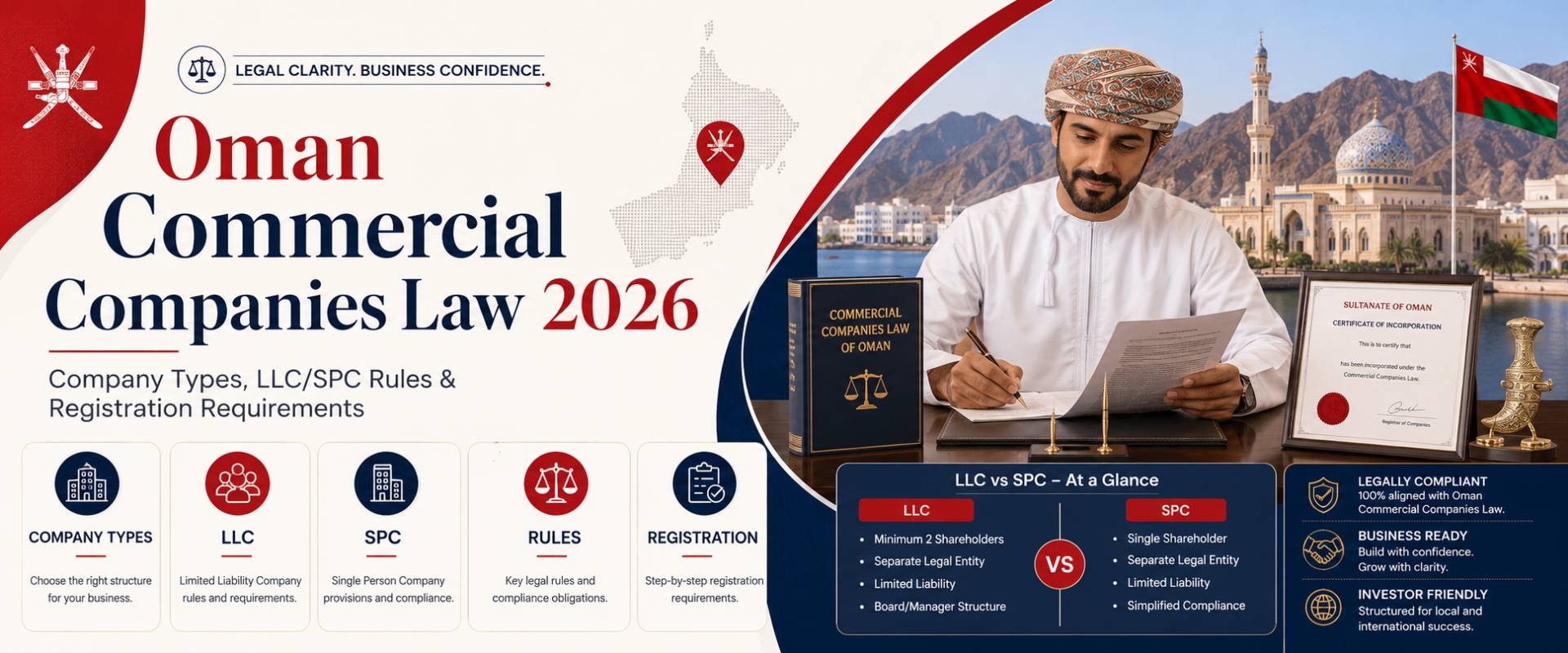

Oman Commercial Companies Law, issued under Royal Decree 18/2019, is the main law that controls how commercial companies are formed, managed, changed, and dissolved in Oman. It replaced the older 1974 Commercial Companies Law and created a modern legal framework for company formation, shareholder rights, company documents, manager duties, share transfers, and ongoing compliance.
For investors, business owners, and entrepreneurs, this law matters because it decides which legal structure you can use, what documents are required, how shareholders are protected, how managers are appointed, and what must be updated with the Commercial Register.
If you are planning to register a company in Oman, this guide gives you a practical explanation of the law without going too deep into legal language. For step-by-step setup support, visit our company registration in Oman service page.
Quick Answer: What Is Oman Commercial Companies Law?
Oman Commercial Companies Law is Royal Decree 18/2019. It governs the formation, operation, management, restructuring, and liquidation of commercial companies in Oman. It applies to companies registered in Oman and sets the rules for legal forms, constitutive documents, shareholder meetings, company management, share transfers, financial records, and commercial registration updates.
In simple terms, this law is the legal foundation behind company formation in Oman. Before choosing an LLC, SPC, branch office, joint stock company, or partnership, investors should understand how this law affects ownership, liability, management, and compliance.
Why This Law Matters for Business Owners
The Commercial Companies Law matters because it affects almost every important decision during and after company registration.
It helps determine:
- Which legal structure is suitable for your business
- Whether one owner or multiple shareholders are required
- What must be included in the Memorandum of Association
- How managers or directors are appointed
- How shareholder decisions are approved
- How shares can be transferred
- What company records must be maintained
- When changes must be filed with the Commercial Register
- What happens if the company is dissolved or liquidated
Choosing the wrong structure can lead to future amendments, partner disputes, share transfer problems, or unnecessary compliance costs. This is why business structure planning should happen before submitting a registration application.
For legal document drafting, MoA updates, shareholder records, and company compliance, our corporate secretary services in Oman can help.
Purpose and Scope of Royal Decree 18/2019
Royal Decree 18/2019 modernised Oman’s company law framework. The law applies to commercial companies whose main place of business is in Oman or whose main business activity is carried out in Oman.
The law was created to:
- Modernise company formation rules
- Improve corporate governance
- Clarify shareholder rights
- Define manager and director responsibilities
- Support digital company procedures
- Regulate share transfers and company amendments
- Improve investor protection
- Create clearer rules for liquidation and dissolution
It works alongside other important laws and authority procedures, including MOCIIP regulations, Commercial Register rules, Foreign Capital Investment rules, tax rules, labour rules, and sector-specific licence requirements.
Company Types Under Oman Commercial Companies Law
The Commercial Companies Law recognises different company structures. The right structure depends on ownership, liability, capital, management, business activity, and future growth plans.
| Company Type | Best For | Key Point |
|---|---|---|
| Limited Liability Company | SMEs, partnerships, investors, family businesses | Common structure for multi-owner businesses |
| Single Person Company | One-owner businesses and solo entrepreneurs | One owner with limited liability protection |
| Joint Stock Company | Larger private or public businesses | Used for bigger capital and formal governance |
| General Partnership | Small partner-led businesses | Partners may carry wider liability |
| Limited Partnership | Investment or project structures | Has general and limited partners |
| Branch Office | Foreign companies entering Oman | Linked to the foreign parent company |
| Holding Company | Group structures | Used to hold shares in other companies |
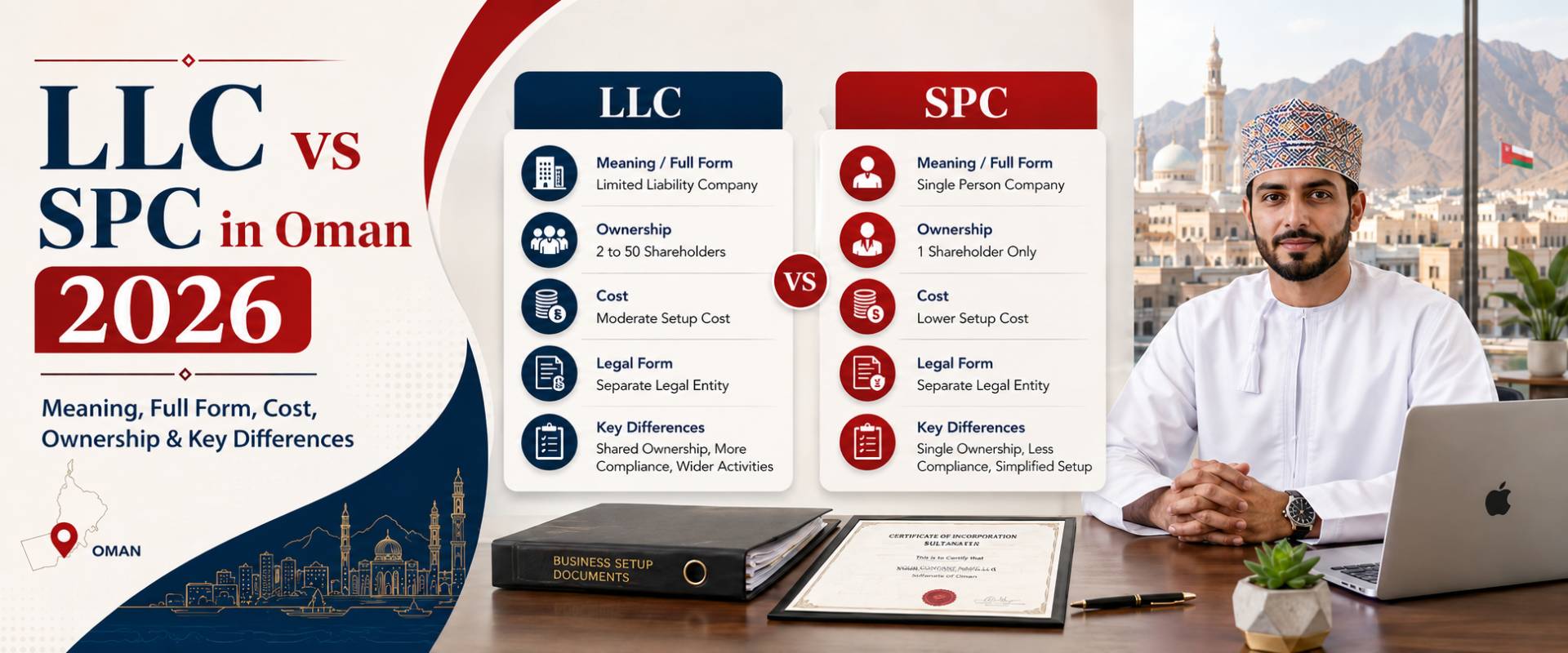
Most small and medium investors compare LLC and SPC first because these are the most practical structures for many company setup cases.
For a direct comparison, read our guide on LLC vs SPC in Oman.
LLC Under Oman Commercial Companies Law
A Limited Liability Company, or LLC, is one of the most common company structures in Oman. It is usually used when there are multiple shareholders, business partners, investors, or family members involved in the company.
An LLC is suitable for:
- Trading companies
- Service businesses
- Restaurants and cafés
- Construction and contracting businesses
- Import-export companies
- Logistics companies
- Professional service firms
- Family-owned businesses
- Foreign investor businesses
The main advantage of an LLC is limited liability. This means shareholders are generally liable only up to their share in the company, unless there is fraud, personal guarantee, misuse of company funds, or serious non-compliance.
For LLC setup support, visit our LLC company registration in Oman page.
Single Person Company Under Oman Commercial Companies Law
A Single Person Company, often called SPC or one-person company, is a company owned by one person or one legal entity. It gives a solo business owner limited liability protection while allowing full control over the company.
An SPC can be useful for:
- Solo consultants
- Freelancers
- Digital service providers
- E-commerce owners
- Small traders
- Independent professionals
- Business advisors
- Marketing, design, and IT service providers
The benefit of an SPC is that the owner does not need partners but still gets a separate legal company structure. This is different from a traditional sole proprietorship, where personal liability can be higher.
If you are starting alone, read our guide on how to register an SPC company in Oman.
What the Law Means for Company Registration
Before applying for company registration, the Commercial Companies Law affects the basic setup decisions.
It helps define:
- Company legal form
- Ownership structure
- Shareholder documents
- Manager powers
- Company capital details
- Registered office requirement
- Commercial Register filing
- Memorandum of Association content
- Share transfer rules
- Amendment procedures
For example, if you choose an LLC, you need shareholder details, ownership percentages, manager appointment rules, and company governance provisions. If you choose an SPC, the company documents will show one owner and a simpler ownership structure.
For the registration process itself, read our guide on Commercial Registration in Oman.
Memorandum of Association and Company Documents
The Memorandum of Association is one of the most important company documents under the Commercial Companies Law. It explains how the company is formed, owned, managed, and operated.
A proper MoA usually includes:
- Company name
- Legal structure
- Registered address
- Business activities
- Shareholders or owner details
- Capital structure
- Ownership percentages
- Manager appointment
- Signing authority
- Profit distribution rules
- Share transfer rules
- Dispute and amendment provisions
Company documents should be carefully prepared because errors can create future problems with banks, shareholders, MOCIIP filings, licences, and share transfers.
The law also requires constitutive documents and amendments to be written in Arabic. If foreign-language documents are used, proper translation and attestation may be required.
Shareholder Rights Under Oman Company Law
Shareholders have important rights under the Commercial Companies Law and company documents.
Common shareholder rights include:
- Right to profit distribution based on shareholding
- Right to vote on company decisions
- Right to attend shareholder meetings
- Right to review company accounts and records
- Right to approve major company changes
- Right to transfer shares subject to legal rules
- Right to appoint or remove managers where applicable
- Right to protect their interest in case of unfair conduct
In an LLC, shareholder rights should be clearly reflected in the Memorandum of Association and any shareholder agreement. This is especially important when one partner is a majority shareholder and another is a minority shareholder.
Minority Shareholder Protection
The Commercial Companies Law gives importance to shareholder protection, especially in companies with multiple owners. This is important for joint ventures, family businesses, and foreign investor partnerships.
Minority shareholder protection may include:
- Right to inspect company records
- Right to attend and vote at meetings
- Pre-emption rights on share transfers
- Right to challenge unfair conduct
- Right to request meetings in certain cases
- Right to court protection in serious disputes
For investors, these rules are important because they reduce the risk of one shareholder making major decisions without following proper procedures.
A strong shareholder agreement can help avoid disputes by clearly explaining voting rights, exit terms, share transfer rules, and dispute resolution steps.
Manager and Director Duties
The law sets responsibilities for managers and directors. In an LLC, managers play an important role because they usually control daily operations, signing authority, filings, and company decisions.
Managers and directors should:
- Act in the best interest of the company
- Follow the company’s objectives
- Avoid conflicts of interest
- Maintain proper company records
- Avoid misuse of company funds
- Follow the Memorandum of Association
- File required updates with the Commercial Register
- Avoid trading outside approved business activities
- Avoid decisions that harm the company or shareholders
Managers may face liability if they act negligently, breach company documents, misuse authority, or violate legal requirements.
This is why business owners should not treat company management as only a formality. Manager powers and limitations should be clearly documented.
Share Transfer Rules
Share transfers in Oman must follow legal and company document requirements. This is especially important for LLC companies.
A share transfer may be needed when:
- A partner exits the company
- A new investor joins
- Ownership percentage changes
- A foreign investor buys shares
- A family business restructures
- A company is sold
Typical share transfer steps may include:
- Written notice to shareholders
- Review of pre-emption rights
- Shareholder approval, if required
- Notarised share transfer agreement
- MOCIIP or Commercial Register update
- Bank and licence record updates
- Tax and accounting record updates
If share transfers are done incorrectly, the Commercial Register may not accept the change, and disputes may arise between shareholders.
Compliance Obligations Under the Law
After company registration, businesses must continue maintaining compliance. Registration is not the end of the process.
Common compliance obligations include:
- Maintaining correct Commercial Register details
- Updating shareholder or manager changes
- Renewing applicable licences
- Keeping company records
- Maintaining accounting records
- Preparing financial statements where required
- Filing tax returns
- Updating Memorandum of Association changes
- Maintaining Chamber or authority memberships where applicable
- Following sector-specific rules
If the company changes address, activities, managers, shareholders, or legal structure, the Commercial Register should be updated properly.
For bookkeeping and tax filing support, visit our accounting and bookkeeping services in Oman page.
Foreign Investors and the Commercial Companies Law
Foreign investors setting up a business in Oman must consider the Commercial Companies Law along with foreign investment rules and activity approvals.
The law provides the company structure framework, while foreign investment rules and MOCIIP procedures determine whether a foreign investor can own the activity fully, needs additional approval, or must follow a specific setup route.
Foreign investors should check:
- Business activity eligibility
- Ownership rules
- Legal structure
- Investor visa requirements
- Capital expectations
- Office lease requirements
- Tax registration
- Sector licence requirements
- Banking requirements
Many foreign investors use LLC or SPC structures depending on ownership plan and activity type.
For ownership planning, read our 100% foreign ownership in Oman guide.
Company Registration Requirements Under the Law
A standard company registration under the Commercial Companies Law may require:
- Trade name reservation
- Legal structure selection
- Memorandum of Association
- Shareholder identification documents
- Registered office lease
- Business activity selection
- Manager appointment
- Commercial Register filing
- Sector approval, if needed
- Payment of applicable fees
After approval, the company receives its Commercial Registration certificate and CR number.
For CR number details, read our company registration number in Oman guide.
Common Mistakes to Avoid
Business owners should avoid these mistakes:
- Choosing LLC when SPC is more suitable
- Choosing SPC when partners will be added soon
- Using weak or incomplete MoA wording
- Not documenting shareholder rights
- Ignoring manager powers
- Not checking activity approval before registration
- Not updating the Commercial Register after changes
- Doing share transfers without proper legal process
- Confusing company registration with business licence
- Ignoring annual tax and accounting compliance
- Using outdated foreign ownership information
- Not keeping company records properly
These mistakes can cause delays, disputes, bank account issues, licensing problems, and amendment costs.
When You Should Get Professional Help
Professional guidance is useful when:
- Foreign investors are involved
- Multiple shareholders are involved
- You need an LLC or SPC comparison
- You need MoA drafting
- You are transferring shares
- You are changing company structure
- You are adding or removing partners
- You are entering a regulated sector
- You need investor visa planning
- You need annual compliance support
For company documents, shareholder changes, and legal structure support, use our corporate secretary services in Oman.
Frequently Asked Questions
What is the Oman Commercial Companies Law?
Oman Commercial Companies Law is Royal Decree 18/2019. It regulates the formation, management, shareholder rights, manager duties, share transfers, compliance, and dissolution of commercial companies in Oman.
What company types are recognised under Oman company law?
The law recognises several company forms, including Limited Liability Company, Single Person Company, joint stock companies, partnerships, branch structures, and other approved commercial forms.
Does the Commercial Companies Law apply to LLC companies?
Yes. LLC companies are regulated under the Commercial Companies Law. The law affects shareholder rights, manager duties, company documents, share transfers, and compliance requirements.
What is a Single Person Company under Oman law?
A Single Person Company is a company owned by one natural or legal person. It gives one owner limited liability protection and a separate company identity.
Why is the law important for company registration?
The law decides which company structure can be used, what documents are required, how shareholders are protected, how managers are appointed, and how company changes must be registered.
Do company documents need to be in Arabic?
Yes, constitutive documents and amendments generally need to be prepared in Arabic and registered according to the required process.
What is the role of the Memorandum of Association?
The Memorandum of Association sets out the company name, activity, shareholders, ownership percentages, capital, manager powers, profit distribution, and governance rules.
Can shares be transferred freely in an LLC?
Share transfers must follow the Commercial Companies Law, the company’s MoA, and Commercial Register requirements. Existing shareholders may have pre-emption rights before shares are transferred to a third party.
What happens if a company does not update the Commercial Register?
Failure to update company changes can create compliance issues, banking delays, licence problems, and possible authority penalties.
Is this law enough to start a business in Oman?
No. The law gives the company structure framework, but business setup also requires MOCIIP procedures, Commercial Registration, tax registration, licences, office requirements, and sector approvals.
Conclusion
Oman Commercial Companies Law under Royal Decree 18/2019 is the main legal framework for forming and managing companies in Oman. It explains the available legal structures, shareholder rights, manager duties, share transfer rules, company document requirements, and ongoing compliance obligations.
For most investors, the key decision is choosing the right structure before registration. LLC is usually suitable for partnerships and multi-shareholder businesses, while SPC is suitable for one-owner businesses. The correct structure depends on ownership, activity, liability, management, investment plan, and future growth.
Before registering a company, investors should review the business activity, legal form, shareholder rights, MoA requirements, Commercial Register updates, and compliance obligations. This avoids delays, disputes, and amendment costs later.
Oman Business Setup helps local and foreign investors with company registration, LLC setup, SPC registration, Memorandum of Association drafting, shareholder records, Commercial Register updates, and corporate compliance.
For help with legal structure selection and company formation, contact our company registration in Oman team or speak with our business setup consultants in Oman.
Legal Disclaimer
This guide is for general information only and does not replace legal advice. Oman Commercial Companies Law, company registration procedures, foreign ownership rules, capital requirements, licence requirements, and compliance obligations may change. Always verify current requirements through official government sources or qualified consultants before registering or changing a company.
About the Author
Shuja Ahmad is part of the Oman Business Setup consultant team and writes about company formation, Commercial Registration, LLC setup, SPC registration, shareholder documentation, investor visas, and corporate compliance in Oman. His content focuses on practical setup steps, legal structure selection, authority requirements, and common reasons company registration applications get delayed.