

Published by Shuja Ahmad | Business Setup Consultant | MakeMyCompany | Updated: March 2026
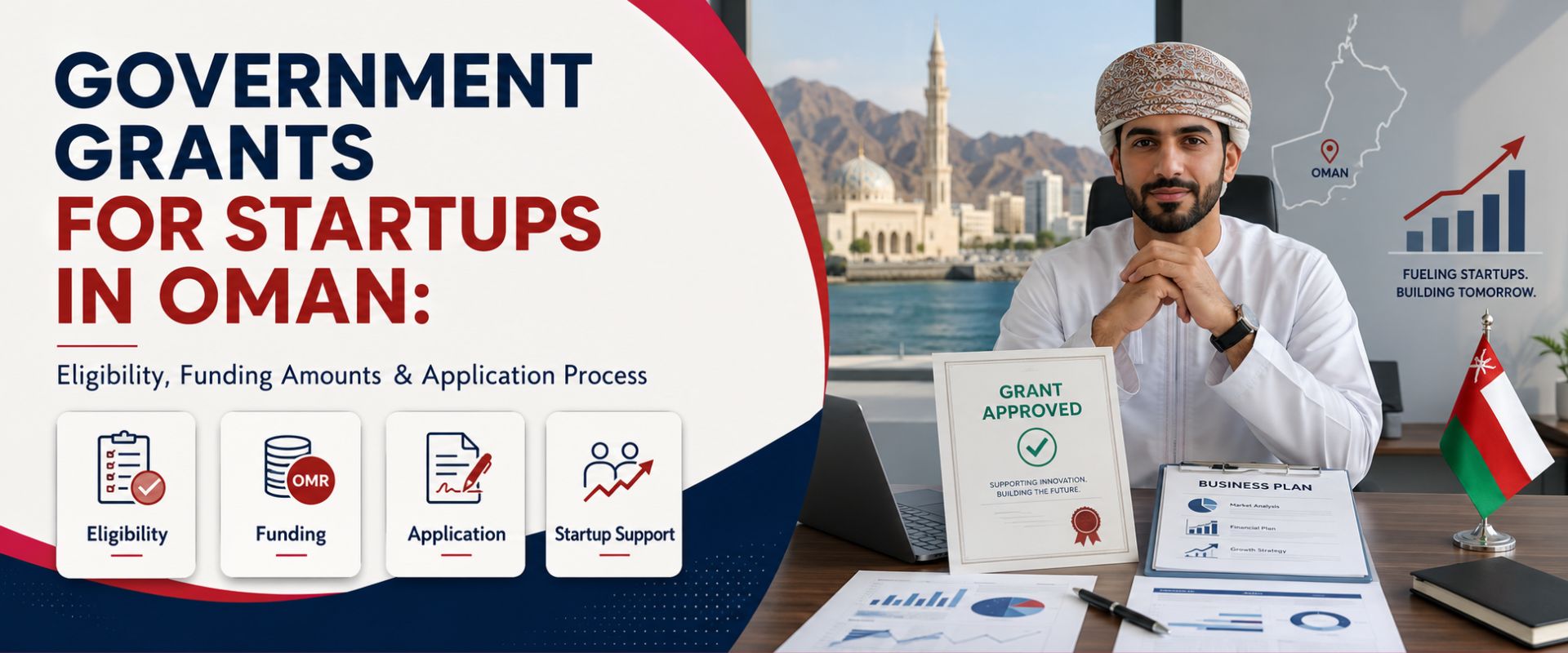
Securing startup funding in Oman is one of the most practical steps a new entrepreneur can take after registering a company. The Omani government has built a structured network of SME funding programs, government grants, and loan schemes designed to support early-stage businesses across multiple sectors. This guide covers the actual programs available, who qualifies, how much funding is accessible, and the realistic application process in 2026.
Before applying for any government support, your business must be legally registered in Oman. If you have not yet completed company registration, read our guide on how to start a business in Oman which covers the full step-by-step process.
Government Startup Grants and SME Funding Programs in Oman (2026)
Oman does not operate a single centralised grant portal. Instead, startup funding in Oman is distributed across several government bodies, each with its own mandate, eligibility criteria, and funding type. Below are the primary programs active in 2026.
| Program | Administering Body | Funding Type | Who Qualifies |
| Riyada SME Support Program | Public Authority for SME Development (Riyada) | Grants and subsidised loans | Omani-owned SMEs with valid CR |
| Oman Development Bank (ODB) Startup Loan | Oman Development Bank | Concessional loan (low interest) | Omani nationals, priority sectors |
| National Technology Fund (NTF) | Ministry of Transport, Communications and IT | Grant and equity | Tech startups, ICT, innovation |
| Oman Innovation Fund (OIF) | Oman Investment Authority | Grant funding and co-investment | R&D, manufacturing, green tech |
| SANAD Program | Riyada | Financial support for SMEs | Early-stage Omani businesses |
| IsDB Financing (via ODB) | Islamic Development Bank / ODB | Islamic finance instruments | Eligible project-based businesses |
| Youth Entrepreneurship Program | Ministry of Labour / Riyada | Seed grant | Omani youth (under 35) |
For the most current program status and application windows, check the official Riyada SME portal and the Oman Development Bank website directly.
Riyada Grants for SMEs in Oman: What You Actually Get
Riyada (the Public Authority for Small and Medium Enterprise Development) is the primary government body managing SME funding in Oman. Understanding what Riyada actually provides is important because many entrepreneurs confuse its programs with outright non-repayable grants.
Riyada SANAD Program: The SANAD program provides financial support to Omani-owned small businesses at concessional rates. Support includes partial loan guarantees, subsidised financing, and, in some cases, direct financial assistance for qualifying operational costs. Businesses in manufacturing, food production, and craft industries are prioritised.
Riyada Business Incubation Support: Riyada operates business incubation centers across Oman that provide subsidised workspace, mentoring, and access to government procurement channels. Startups accepted into incubation programs may receive indirect financial support through reduced operating costs.
Who Qualifies for Riyada Support:
- Business must be majority-owned by Omani nationals (51% minimum)
- Valid Commercial Registration (CR) from MOCIIP required
- Annual revenue below OMR 1.5 million for small enterprise classification
- Business activity must fall within Riyada’s priority sectors
- No existing defaults on government loans or obligations
Oman Development Bank Startup Loans: Rates and Eligibility
The Oman Development Bank is the primary lender for project-based and startup financing outside the commercial banking system. ODB offers concessional loans at significantly lower interest rates than commercial banks, specifically for priority economic activities.
Key ODB Loan Features in 2026:
- Interest rates from 2% to 5% per annum, depending on sector and loan size
- Loan amounts from OMR 5,000 up to OMR 1,000,000 for qualifying projects
- Repayment periods of 3 to 15 years with grace periods available
- Priority sectors: agriculture, fisheries, manufacturing, tourism, healthcare, and education
- Omani national ownership requirement applies to most programs
ODB also channels Islamic Development Bank (IsDB) financing instruments into Oman for eligible project-based businesses seeking Shariah-compliant funding. These instruments are particularly relevant for manufacturing and infrastructure projects.
Startup Funding for Tech Businesses: The National Technology Fund
Technology startups have a dedicated funding pathway through the National Technology Fund (NTF), administered under the Ministry of Transport, Communications, and Information Technology. The NTF was established specifically to support Oman’s digital transformation agenda under Vision 2040.
NTF Funding Areas:
- Software development and digital services
- Artificial intelligence and machine learning applications
- Cybersecurity products and services
- Smart city technology solutions
- E-commerce infrastructure and fintech platforms
The NTF provides a combination of grant funding and equity participation for early-stage technology companies. Applications are assessed on commercial viability, technical innovation, and alignment with Oman’s national digital strategy. Foreign co-founders may apply, but Omani co-ownership is typically expected for grant components.
Who Qualifies for Government Business Funding in Oman: Eligibility Matrix
Eligibility varies significantly across programs. The table below summarises the key qualifying criteria across the main funding bodies.
| Criteria | Riyada | Oman Dev Bank | Natl Tech Fund | Oman Innovation Fund |
| Omani majority ownership required | Yes (51%+) | Yes | Preferred | Case by case |
| Minimum operating period | None (startups eligible) | None | None | 6 months preferred |
| Sector restrictions | Priority sectors preferred | Priority sectors only | ICT and tech only | R&D and innovation |
| Foreign co-founders allowed | No (for grants) | No | Partial | Yes (equity rounds) |
| Formal business plan required | Yes | Yes | Yes (technical) | Yes |
| Maximum annual revenue for eligibility | OMR 1.5 million | No formal cap | No formal cap | No formal cap |
| Repayment required | Partial (loans) | Yes (concessional) | Grant portion: No | Equity: No |
Government Grants vs Government Loans for Startups in Oman
A common misunderstanding among new entrepreneurs is treating all government funding as non-repayable grants. In practice, most Omani government support comes as concessional loans, loan guarantees, or equity participation rather than outright grants.
| Funding Type | Repayment | Interest | Common Source | Best For |
| Non-repayable grant | No | None | NTF, specific Riyada programs | Tech innovation, social enterprise |
| Concessional loan | Yes | 2% to 5% p.a. | ODB, Riyada SANAD | Manufacturing, agriculture, tourism |
| Loan guarantee | Yes (via bank) | Commercial rate (partially subsidised) | ODB, Riyada | Businesses needing bank access |
| Equity participation | No (dilution instead) | None | OIF, NTF | High-growth tech and R&D startups |
| Subsidised workspace/services | No | None | Riyada incubators | Early-stage businesses |
Understanding this distinction before applying saves significant time. If your business model cannot service any debt, focus specifically on the NTF grant track and Riyada incubation programs rather than ODB financing.
How to Apply for Government Startup Funding in Oman: Step-by-Step
The application process differs by program but follows a broadly consistent sequence across all government funding bodies.
- Verify your business registration is current and in good standing through the
Verify your business registration is current and in good standing through the Invest Easy portal. No government funding application will progress without a valid CR.
- Identify the correct program for your business type, sector, and ownership structure using the eligibility matrix above.
- Prepare your business plan. This must include: an executive summary, a market analysis, 3-year financial projections, details of how the funding will be deployed, and expected employment and revenue outcomes.
- Gather supporting documents. Standard requirements include: a CR certificate, an MOA, copies of shareholders’ IDs, bank statements for the past 6 months if operating, a tax registration certificate, and a tenancy agreement for the business premises.
- Submit your application to the relevant body. Riyada applications go through riyada.om. ODB applications are submitted directly at ODB branches or online. NTF applications are managed through the MCIT portal.
- Attend any required interview or pitch session. Both NTF and OIF typically require a presentation from the founding team before funding decisions are made.
- Follow up after 4 to 8 weeks if no response has been received. Processing timelines vary significantly: Riyada assessments typically take 4 to 6 weeks, ODB credit assessments take 6 to 12 weeks, and NTF rounds operate on a cohort basis, with defined timelines published for each round.
Why Government Funding Applications Get Rejected in Oman
Understanding rejection patterns helps applicants address weaknesses before submission.
- Incomplete business plan: Weak financial projections are the most common reason for rejection across all programs. Funding bodies want to see realistic revenue forecasts with clear assumptions, not aspirational numbers.
- Activity not in priority sectors: ODB and Riyada prioritise specific activities. General trading, retail, and professional services face significantly higher rejection rates than manufacturing, food production, and technology.
- The ownership structure does not meet the requirements: Foreign-majority companies are automatically ineligible for most Riyada and ODB programs. Confirm the ownership split on your CR before applying.
- Existing government loan defaults: Any outstanding defaults on government-backed financing will result in immediate rejection. Resolve these before applying.
- No physical premises: Most programs require a valid tenancy agreement with a physical registered address. P.O. Box addresses are not accepted.
- Lack of market validation: For NTF and OIF applications, demonstrating existing customer traction, letters of intent, or pilot results significantly increases the likelihood of approval.
Realistic Timeline: From Application to Funding Receipt
| Stage | Estimated Duration |
| Business plan preparation | 2 to 4 weeks |
| Document gathering and verification | 1 to 2 weeks |
| Application submission and initial review | 1 to 2 weeks |
| Assessment, credit check or technical review | 4 to 12 weeks |
| Approval notification | 1 to 2 weeks |
| Funding agreement signing and disbursement | 2 to 4 weeks |
| Total realistic timeline | 3 to 6 months from start to funds received |
Entrepreneurs who need capital within 60 days should explore commercial bank financing or private investment options while preparing government funding applications in parallel.
Startup Funding After Company Registration in Oman
Most government funding programs require a registered company as a baseline. Entrepreneurs who apply before completing formal registration will be rejected at the documentation stage, regardless of the quality of their business plan.
The practical sequence is: complete company registration, open a corporate bank account, obtain your commercial license, and then begin preparing funding applications. For guidance on each step in that process, read our article on company registration requirements in Oman. Understanding your registered business activity is also critical because it determines your eligibility across most government programs.
Foreign entrepreneurs who are ineligible for Riyada or ODB programs due to ownership requirements may explore funding options in Oman’s free zones, including Sohar Free Zone and Knowledge Oasis Muscat (KOM), both of which offer startup support mechanisms, including subsidised lease rates and sector-specific incentives.
FAQs About Government Grants and Startup Funding in Oman
Can foreigners apply for government grants in Oman?
Most Riyada and ODB programs require a majority Omani ownership (51% or more). The National Technology Fund and Oman Innovation Fund may consider applications with foreign co-founders on a case-by-case basis, particularly where Omani co-founders hold equity. Free zone startups have access to separate zone-specific incentives regardless of ownership structure.
Is there a non-repayable startup grant available in Oman?
Yes, but it is not common. The NTF grant track and specific Riyada incubation programs offer non-repayable support for qualifying technology and innovation businesses. Most other government support in Oman takes the form of concessional loans, guarantees, or equity participation rather than outright grants.
What is the Riyada SANAD program?
SANAD is a Riyada program that provides financial support to Omani-owned small businesses, primarily through concessional financing and loan guarantees. It is designed to help SMEs access capital that commercial banks might not otherwise provide to early-stage businesses without a credit history.
What does the Oman Development Bank fund?
ODB provides concessional loans for projects in priority sectors, including agriculture, fisheries, manufacturing, tourism, education, and healthcare. Loan amounts range from OMR 5,000 to OMR 1,000,000. Omani national ownership is required for most ODB financing programs.
How long does it take to receive startup funding in Oman?
From initial application to fund disbursement, the realistic timeline is 3 to 6 months, depending on the program and complexity of the application. Applications for technology funds reviewed in cohort rounds may take longer if your submission falls between rounds.
Final Summary
Government grants and startup funding in Oman are real and accessible. Still, they require proper company registration, a detailed business plan, and a clear understanding of which program matches your business type and ownership structure. Generic applications without sector alignment, realistic financials, and complete documentation consistently fail across all programs.
Riyada SME funding, Oman Development Bank loans, and the National Technology Fund each serve distinct segments of the startup ecosystem. Mapping your business to the right program before applying is the single most effective way to improve your approval chances.
If you need support with company registration before applying for any of these programs, MakeMyCompany is a business setup consultancy based in Muttrah, Muscat, Oman. Shuja Ahmad and the team assist entrepreneurs with company formation, licensing, and regulatory compliance to ensure their businesses meet the foundational requirements of government funding programs.
About the Author
Shuja Ahmad is a business setup consultant at MakeMyCompany, based in Muttrah, Muscat, Oman. He specialises in company registration, commercial licensing, and regulatory compliance for entrepreneurs setting up businesses in Oman. His practical experience spans hundreds of company formations across mainland and free zone jurisdictions, with specific expertise in guiding startups through the government funding eligibility requirements that apply post-registration.