

British entrepreneurs and international investors increasingly recognize Oman as a strategic gateway to Middle Eastern markets, offering political stability, business-friendly regulations, and attractive investment opportunities. If you’re based in the UK and considering company registration in Oman, understanding the remote establishment process, legal requirements, and documentation procedures is essential for success. This comprehensive guide provides step-by-step instructions for UK residents seeking to establish a business in Oman without needing to travel initially, covering everything from business structures to licensing, ensuring your cross-border venture launches smoothly and legally.
Table of Contents
Why UK Entrepreneurs Choose Oman for Business Expansion
Understanding Oman’s competitive advantages helps UK investors make informed decisions about Middle Eastern market entry strategies.
Strategic Geographic Location
Oman’s position at the entrance to the Arabian Gulf provides unparalleled access to GCC markets, East African trade routes, and Asian business corridors. UK companies can leverage Oman as a regional hub serving Saudi Arabia, UAE, Qatar, Kuwait, and emerging African markets. The country’s world-class ports including Salalah and Duqm facilitate international trade and logistics operations.
100% Foreign Ownership Permitted
Recent regulatory reforms allow foreign investors complete ownership in most business sectors without requiring local Omani partners. This liberalization particularly benefits UK entrepreneurs wanting full control over operations, intellectual property, and business decisions. Sectors including technology, professional services, consulting, trading, and manufacturing welcome 100% foreign ownership.
Political Stability and Security
Oman maintains exceptional political stability, neutral foreign policy, and a secure business environment rarely matched in the Middle East. UK businesses value this predictability for long-term investment planning, protecting assets, and ensuring operational continuity. The Sultanate’s peaceful reputation attracts international talent and facilitates partnerships.
Tax Advantages and Incentives
Oman offers competitive corporate tax rates, numerous tax exemptions for specific sectors, free zones with additional tax benefits, no personal income tax, and bilateral tax treaties including agreements with the United Kingdom preventing double taxation. These fiscal advantages enhance profitability for UK companies operating in Oman.
Growing Economic Opportunities
Vision 2040 drives economic diversification creating demand for international expertise in tourism development, renewable energy projects, logistics and transportation, healthcare and education services, and technology and digital transformation. UK companies with expertise in these sectors find substantial opportunities and government support.
Understanding Business Structures Available for UK Companies
Selecting the appropriate legal structure impacts taxation, liability, operational flexibility, and regulatory compliance.
Limited Liability Company (LLC)
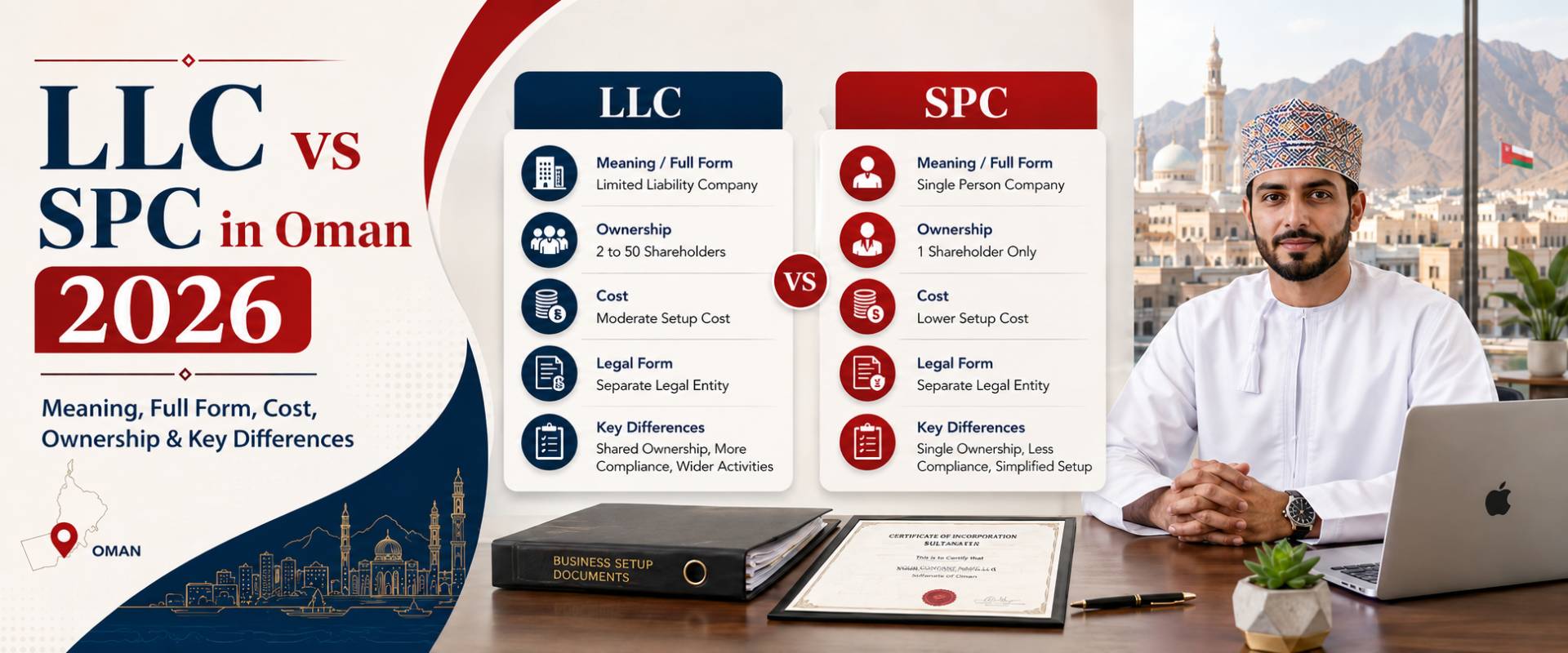
The Limited Liability Company represents the most common structure for UK investors establishing operations in Oman. LLCs offer shareholder liability protection limited to capital contributions, flexibility in ownership structure (now permitting 100% foreign ownership in many sectors), and minimum capital requirements of OMR 150,000 for general businesses (reduced to OMR 20,000-50,000 for technology and professional firms). UK entrepreneurs can own LLCs entirely without local partners in permitted sectors.
Single Person Company (SPC)
Single Person Companies suit individual UK investors or single-shareholder corporations, offering simplified governance compared to multi-shareholder LLCs, complete ownership control, and similar liability protection as LLCs. SPCs work well for consultants, freelancers, or small business owners testing the Omani market before scaling operations.
Branch Office
UK companies with established operations can register branch offices in Oman, operating as extensions of the parent UK entity. Branches enable conducting business under the parent company name, leveraging established brand reputation, and simplified accounting as branches are not separate legal entities. However, branches face restrictions on certain business activities and require demonstrating parent company financial strength.
Representative Office
Representative offices permit UK companies to conduct market research, explore business opportunities, and establish relationships without engaging in direct commercial transactions. These non-profit entities cannot invoice clients or generate revenue but facilitate market entry preparation. Representative offices suit companies evaluating Omani market viability before full commitment.
Free Zone Companies
Oman’s free zones including Knowledge Oasis Muscat, Salalah Free Zone, and Duqm Special Economic Zone offer attractive benefits including 100% foreign ownership guaranteed, corporate tax exemptions (up to 30 years), customs duty waivers, 100% profit repatriation, and streamlined licensing procedures. UK businesses focusing on export, manufacturing, or technology development benefit from free zone establishment.
Legal Requirements for UK Residents Registering Companies in Oman
Understanding regulatory requirements ensures compliant establishment from the United Kingdom.
Company Name Reservation
UK entrepreneurs must reserve company names through Oman’s Invest Easy portal ensuring names aren’t already registered, comply with Omani naming conventions, don’t contain offensive or misleading terms, and include appropriate Arabic translations. Name reservation typically processes within 1-2 business days after online submission.
Minimum Capital Requirements
Capital thresholds vary by business structure and sector. General LLCs require OMR 150,000 minimum capital, technology and professional services companies need OMR 20,000-50,000, free zone companies have varying requirements (often lower), and branch offices demonstrate parent company financial capacity rather than depositing capital in Oman. UK investors must deposit required capital into Omani bank accounts providing proof during registration.
Constitutional Documents
All companies need Memorandum of Association (MoA) and Articles of Association (AoA) drafted in Arabic, notarized by authorized notaries, specifying business objectives and activities, defining shareholder rights and responsibilities, and outlining governance structures. UK residents can prepare these documents remotely through legal service providers in Oman.
Registered Office Address
Omani regulations require physical business addresses within the Sultanate. UK companies can secure premises through commercial property leases, serviced office agreements, or free zone facilities. Virtual offices meet requirements for some professional services but verify acceptability with regulatory authorities for your specific activities.
Regulatory Approvals
Depending on business activities, obtain licenses from the Ministry of Commerce, Industry and Investment Promotion (MOCIIP), sector-specific regulatory authorities (banking, insurance, healthcare), Oman Chamber of Commerce and Industry (OCCI) membership, and Oman Tax Authority registration. Each approval requires specific documentation and processing times.
Step-by-Step Process to Register a Company in Oman from the UK
Follow this systematic approach to establish your Omani business remotely from the United Kingdom.
Step 1: Determine Your Business Structure and Activities
Define your intended business operations, target markets, and service offerings. Research whether your planned activities permit 100% foreign ownership or require Omani partnership. Consult Oman’s foreign investment lists identifying permitted, restricted, and prohibited sectors for international investors.
Step 2: Engage Local Legal and Business Advisors
While UK entrepreneurs can initiate processes remotely, engaging Omani legal advisors, business consultants, or company formation agents significantly streamlines establishment. Local experts navigate bureaucracy, liaise with authorities, ensure document compliance, and accelerate approvals. Many UK companies use professional services combining British accessibility with Omani local expertise.
Step 3: Reserve Your Company Name
Access the Invest Easy portal (www.investeasy.gov.om) creating an account with your UK passport and contact details. Search available company names ensuring uniqueness and appropriateness. Submit name reservation applications with required fees (approximately OMR 10-20) payable via international credit cards. Receive approval notifications typically within 1-2 business days.
Step 4: Prepare Constitutional Documents
Engage legal professionals to draft your Memorandum of Association and Articles of Association in Arabic. These documents specify company name and registration details, business objectives and authorized activities, shareholder information and equity distribution, capital structure and contribution schedules, and management framework and decision-making processes. Ensure documents comply with Omani Commercial Companies Law requirements.
Step 5: Notarize Documents
Constitutional documents require notarization by authorized Omani notaries. If you’re in the UK, your local legal advisor in Oman arranges notarization on your behalf. Alternatively, some documents can be notarized in the UK at the Omani Embassy or Consulate with subsequent authentication in Oman. Verify specific requirements with your advisors as procedures vary.
Step 6: Open Corporate Bank Account
While in the UK, initiate corporate banking relationships with Omani banks having UK presence (like HSBC Oman) or international banks operating in both countries. When you’re ready to Open a Corporate Bank Account in Oman, you can alternatively appoint local representatives with Power of Attorney to open accounts on your behalf. Deposit minimum required capital providing bank certificates during registration. Banks require company documents, shareholder identification, business plans, and source of funds documentation.
Step 7: Submit Company Registration Application
Through Invest Easy or via appointed local agents, submit comprehensive registration applications including reserved name certificate, notarized MoA and AoA, shareholder passport copies and residence details, bank certificate confirming capital deposit, registered office lease agreement or confirmation, and application fees. UK residents can upload documents electronically through the portal.
Step 8: Obtain Commercial Registration Certificate
The Ministry of Commerce, Industry and Investment Promotion (MOCIIP) reviews applications for compliance and completeness. Processing typically requires 7-14 business days for standard applications. Upon approval, receive your Commercial Registration (CR) certificate electronically or through your local representative. The CR certificate authorizes business operations and serves as your company’s official identification.
Step 9: Complete Post-Registration Requirements
After receiving your CR, immediately register with Oman Chamber of Commerce and Industry (OCCI), obtain tax registration from Oman Tax Authority, apply for sector-specific licenses if required, process work visas for any employees, and register for VAT if applicable. Many of these steps can be initiated remotely through online portals or authorized representatives.
Step 10: Appoint Local Representative or Manager
UK-based owners often appoint local Omani managers or foreign residents in Oman to handle daily operations, regulatory liaison, and business development. Define clear responsibilities through Power of Attorney, management agreements, and governance structures protecting your interests while ensuring effective local management.
Documents Required for UK Residents Registering Companies in Oman
Comprehensive documentation ensures smooth approval and prevents delays.
Personal Identification Documents:
- Valid UK passport copies (all shareholders and directors)
- Proof of UK residential address (utility bills, bank statements dated within 3 months)
- Passport-sized photographs
- CV/resume demonstrating business experience
- Police clearance certificate from UK authorities (for certain activities)
Corporate Documents (for UK Company Branch/Subsidiary):
- UK company registration certificate from Companies House
- Memorandum and Articles of Association of UK parent company
- Board resolution approving Oman establishment
- Audited financial statements of UK parent (last 2 years)
- Certificate of Good Standing from UK authorities
- Power of Attorney appointing Oman representative
- Apostilled documents (authenticated by UK Foreign Office)
Omani Company Formation Documents:
- Reserved company name certificate from Invest Easy
- Notarized Memorandum of Association (Arabic)
- Notarized Articles of Association (Arabic)
- Shareholder agreement (if multiple shareholders)
- Proof of minimum capital deposit
- Registered office lease agreement or premises documentation
Financial Documents:
- Bank certificate confirming capital deposit in Omani bank
- Source of funds documentation
- Financial projections for Omani operations (3-5 years)
- Business plan detailing market analysis, strategy, and operations
- Proof of financial capability (bank statements, asset documentation)
Operational Documents:
- Detailed business plan for Omani operations
- Description of products or services offered
- Marketing and distribution strategy
- Organizational structure and staffing plans
- Compliance procedures and quality standards
Apostille and Translation Requirements:
- UK documents require apostille from UK Foreign, Commonwealth & Development Office
- Apostilled documents need Arabic translation by certified translators in Oman
- Original documents plus certified translations submitted during registration
Remote Company Management from the UK
UK entrepreneurs can effectively manage Omani companies remotely through proper structures and technology.
Digital Business Tools
Utilize cloud-based accounting software compliant with Omani regulations, video conferencing for meetings with local staff and authorities, digital signature platforms for document execution (where legally permissible), project management tools coordinating UK and Oman-based teams, and banking apps monitoring financial transactions and approvals remotely.
Local Management Appointment
Appoint trusted local managers or engage management companies handling daily operations, regulatory compliance, client relationships, and staff supervision. Define clear reporting structures, key performance indicators, approval authorities, and communication protocols ensuring alignment with UK-based ownership objectives.
Regular Compliance Monitoring
Implement systems ensuring ongoing regulatory compliance including quarterly financial reviews, annual audit requirements, license renewals tracking, tax filing deadlines, and employee visa renewals. Many UK companies engage Omani business setup consultants providing compliance management services.
Periodic Visits
While remote management is feasible, periodic visits to Oman strengthen local relationships, assess operations firsthand, meet regulatory officials, and demonstrate commitment to the Omani market. Plan quarterly or semi-annual visits during initial years, increasing frequency during critical growth phases or regulatory interactions.
Costs of Registering a Company in Oman from the UK
Understanding comprehensive costs enables proper financial planning for UK investors.
Government and Registration Fees:
- Company name reservation: OMR 10-20
- Commercial Registration: OMR 150-300
- OCCI membership: OMR 150-300
- Tax registration: No fee (compliance requirement)
- Sector-specific licenses: OMR 200-2,000 (varies by activity)
Minimum Capital Requirements:
- Standard LLC: OMR 150,000
- Technology/professional firms: OMR 20,000-50,000
- Free zone companies: Variable (often OMR 10,000-50,000)
Professional Service Fees:
- Legal advisors and document drafting: OMR 2,000-5,000
- Business setup consultants: OMR 3,000-8,000
- Accounting and audit services: OMR 1,500-4,000 annually
- Translation and notarization: OMR 500-1,500
UK Document Authentication:
- UK apostille services: £30-100 per document
- Document courier to Oman: £50-150
- Embassy attestation (if required): £50-200
Office and Infrastructure:
- Virtual office or serviced office: OMR 100-500 monthly
- Commercial property lease deposit: OMR 2,000-8,000
- Office setup and furnishing: OMR 3,000-15,000
Travel and Initial Setup:
- UK-Oman flights (if visiting): £400-800 return
- Accommodation during setup visits: £50-200 per night
- Local transportation and expenses: Variable
Total Investment Estimate: For UK entrepreneurs establishing small to medium Omani companies, expect total costs of OMR 25,000-180,000 (approximately £50,000-360,000) including minimum capital, government fees, professional services, and initial infrastructure. Larger operations or complex structures require higher investments.
Tax Implications for UK Companies Operating in Oman
Understanding cross-border taxation prevents double taxation and optimizes structures.
Oman Corporate Tax
Omani companies pay corporate tax on profits at rates ranging from 3-15% depending on income levels. The UK-Oman double taxation agreement prevents taxing the same income in both countries. Maintain proper documentation demonstrating income sources, tax payments, and treaty eligibility.
UK Tax Considerations
UK resident shareholders may face UK taxation on worldwide income including Omani company dividends. Consult UK tax advisors regarding Controlled Foreign Company (CFC) rules, tax treaty benefits, foreign tax credits, and optimal profit distribution strategies minimizing combined UK-Oman tax burden.
VAT Registration
Omani companies with annual turnover exceeding OMR 38,500 must register for Value Added Tax (VAT) at 5% standard rate. Cross-border services may have different VAT treatment. Understand place of supply rules, zero-rated supplies, and exempt categories ensuring proper VAT compliance.
Transfer Pricing
UK parent companies transacting with Omani subsidiaries must comply with transfer pricing regulations ensuring transactions occur at arm’s length market rates. Maintain transfer pricing documentation justifying intercompany charges, management fees, royalties, and profit allocations.
Common Challenges and Solutions for UK Investors
Understanding potential obstacles helps UK entrepreneurs prepare effective strategies.
Time Zone Differences
The 4-hour time difference between the UK and Oman can complicate real-time communication. Schedule regular calls accommodating both time zones, utilize asynchronous communication tools, and ensure local managers have decision-making authority for time-sensitive matters.
Cultural and Business Practice Differences
Middle Eastern business culture emphasizes relationships, patience, and formal communication differing from typical UK practices. Invest time building personal relationships, show respect for local customs and traditions, and adapt communication styles while maintaining professional standards.
Remote Account Opening Difficulties
Some Omani banks require in-person account opening creating challenges for UK-based investors. Solutions include traveling to Oman for initial banking, using banks with UK branches facilitating introductions, appointing local representatives with banking powers, or utilizing free zones with streamlined banking processes.
Language Barriers
While English is widely used in Omani business, official documents require Arabic. Engage certified translators, retain bilingual legal advisors, and ensure employment contracts and agreements exist in both languages preventing misunderstandings.
Regulatory Navigation
Understanding Omani regulations from the UK can be challenging. Partner with experienced business setup consultants having UK client experience, maintain regular communication with local advisors, and join UK-Oman business networks sharing insights and experiences.
Conclusion
Engaging qualified advisors significantly increases success rates and accelerates establishment timelines.
Several UK consulting firms specialize in Middle Eastern company formation offering familiarity with UK business practices, understanding of British regulatory frameworks, English-language communication, and UK banking relationships facilitating cross-border transactions. These firms bridge cultural and procedural gaps between jurisdictions.
Local Omani consultants provide invaluable ground-level expertise including regulatory authority relationships, up-to-date compliance knowledge, local market insights, and practical establishment support. Many offer dedicated services for international clients including UK investors.
The most effective approach often combines UK-accessible advisors with strong Omani partnerships providing seamless service, bilingual communication, UK time zone availability, and comprehensive local execution. This model offers UK entrepreneurs comfort of familiar business practices with confidence in Omani compliance.