
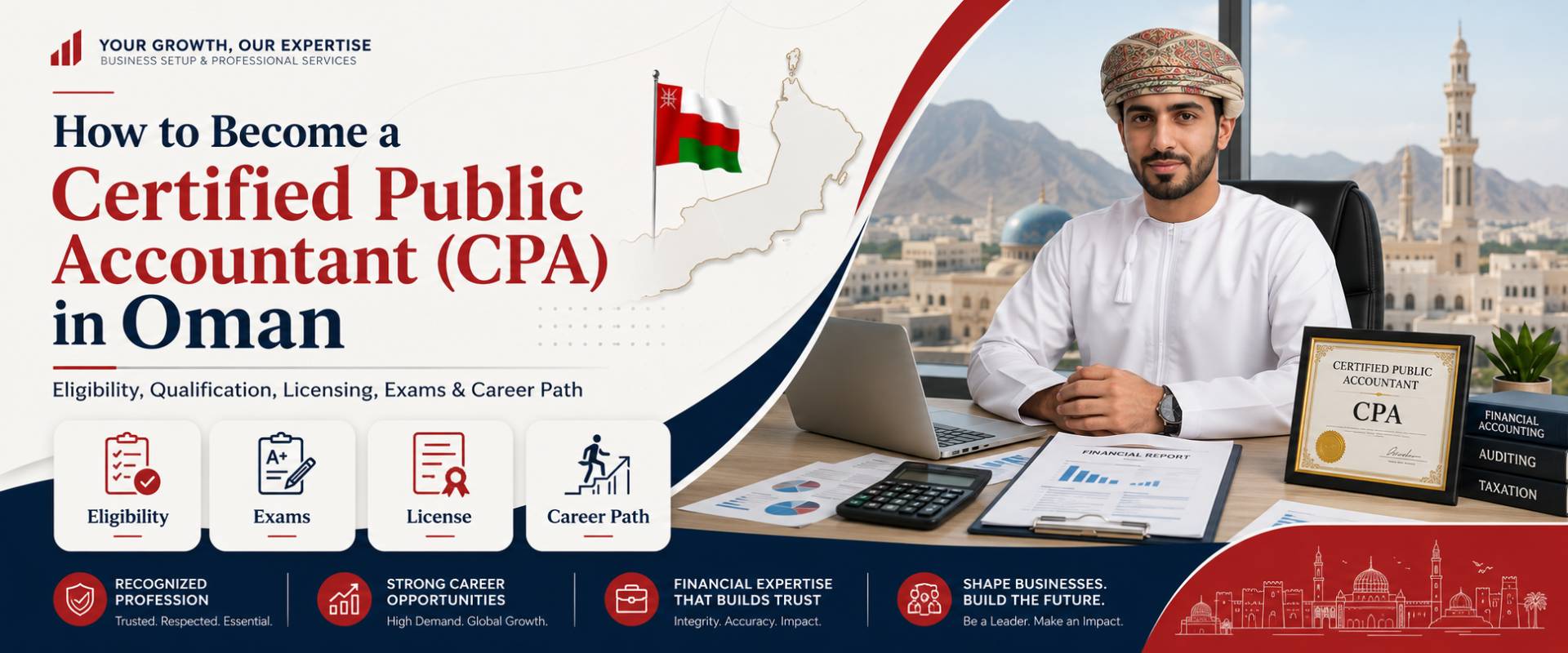
The accounting profession in Oman offers rewarding career opportunities for qualified professionals as businesses require expert financial management, regulatory compliance, and strategic planning. Becoming a Certified Public Accountant (CPA) establishes you as a highly credentialed professional capable of serving clients across diverse industries. Whether you’re a recent graduate, career changer, or international accountant seeking Oman authorization, understanding the complete certification pathway ensures you meet all requirements and position yourself for professional success.
This comprehensive guide explains everything you need to know about obtaining CPA credentials and practicing as a certified accountant in Oman.
Table of Contents
Understanding the CPA Profession in Oman
The Certified Public Accountant designation represents one of the most respected professional credentials in accounting and finance. CPAs provide essential services including financial statement auditing, tax preparation and planning, business consulting and advisory, forensic accounting and fraud examination, and management accounting and strategy.
Regulatory Framework
The Ministry of Commerce, Industry and Investment Promotion (MOCIIP) regulates accounting and auditing professions in Oman. The ministry maintains the Register of Auditors listing qualified professionals authorized to perform statutory audits. Professional practice requires registration demonstrating compliance with educational, examination, and experience requirements.
The Oman Association of Certified Public Accountants serves as the professional body promoting accounting standards, providing continuing education, and advocating for profession interests. Membership connects you with professional networks and resources supporting career development.
Career Opportunities
Certified accountants work across multiple sectors including public accounting firms providing audit, tax, and consulting services to clients, corporate finance departments managing internal accounting and financial planning, government entities overseeing public sector financial management, banks and financial institutions requiring regulatory compliance and risk management, consulting firms offering business advisory and strategic services, and private practice serving SMEs and individual clients.
The CPA credential significantly enhances earning potential, career advancement opportunities, and professional credibility across all sectors.
Educational Requirements for CPA in Oman
Meeting educational prerequisites forms the foundation of CPA qualification in Oman.
Academic Qualifications
You must hold a bachelor’s degree in accounting or finance from a recognized university. The degree should include comprehensive coursework covering financial accounting, managerial accounting, auditing, taxation, business law, economics, and information systems.
Master’s degrees in accounting, finance, or business administration strengthen qualifications though aren’t mandatory. Advanced education demonstrates commitment and provides deeper expertise benefiting complex client engagements.
Degree Recognition
Degrees from Omani universities including Sultan Qaboos University, Dhofar University, and other accredited institutions receive automatic recognition. International degrees require verification through the Ministry of Higher Education, Research and Innovation confirming accreditation status and equivalency to Omani standards.
Degrees from universities in countries with established education systems including the United States, United Kingdom, Canada, Australia, and European nations typically receive recognition. Universities from other regions may require additional evaluation proving academic rigor and comparability.
Required Coursework
Your degree must include minimum credit hours in accounting subjects covering intermediate and advanced financial accounting, cost and managerial accounting, taxation fundamentals and applications, auditing principles and practices, accounting information systems, and business law and ethics.
If your degree lacks specific subject coverage, you may need to complete additional courses through recognized institutions before proceeding to professional examinations.
Professional Certification Pathways in Oman
Several internationally recognized accounting certifications enable practice in Oman, each with distinct requirements and recognition levels.
US CPA License
The American CPA credential from the American Institute of Certified Public Accountants (AICPA) represents the gold standard internationally. Many Omani accounting firms and multinational corporations prefer or require US CPA qualification.
US CPA requirements include 150 semester hours of education (beyond standard bachelor’s degree), passing the Uniform CPA Examination covering Auditing and Attestation (AUD), Financial Accounting and Reporting (FAR), Regulation (REG), and Business Environment and Concepts (BEC). You also need one year of relevant accounting experience under licensed CPA supervision.
The CPA exam can be taken at Prometric testing centers in Oman and other countries. Each section requires separate registration and fees typically totaling $1,000-1,500 for all four sections.
ACCA Qualification
The Association of Chartered Certified Accountants (ACCA) offers globally recognized credentials particularly popular in Commonwealth countries and the Gulf region. ACCA qualification involves completing 13 examinations across knowledge, skills, and professional levels covering accounting fundamentals, corporate reporting, audit and assurance, taxation, and strategic business management.
ACCA also requires three years of relevant practical experience and completion of ethics and professional skills modules. Examinations occur quarterly at designated centers worldwide including Oman.
Total ACCA qualification costs including examination fees, registration, and membership range $3,000-5,000 over the typical 2-4 year completion period.
CMA Certification
The Certified Management Accountant (CMA) credential from the Institute of Management Accountants (IMA) focuses on financial management and strategic planning. CMA requirements include bachelor’s degree from accredited institution, passing two-part examination covering Financial Planning and Analysis, and Strategic Financial Management, and two years of professional experience in management accounting.
CMA certification particularly benefits professionals in corporate finance, internal consulting, and strategic planning roles.
Local Registration
Regardless of which international certification you pursue, practicing as a licensed auditor in Oman requires registration with MOCIIP. Registration demonstrates compliance with local regulatory standards and authorizes signing audit reports and financial statements.
Professional Experience Requirements in Oman
Practical experience proves your ability to apply theoretical knowledge in real-world situations.
Experience Duration
MOCIIP typically requires a minimum three to five years of relevant accounting experience before granting audit registration. Experience should be progressive, demonstrating increasing responsibility and complexity.
Work under supervision of experienced CPAs or chartered accountants already registered with authorities. Your supervisors verify your experience through reference letters and attestations.
Relevant Experience Categories
Acceptable experience includes public accounting performing audits, tax preparation, and consulting services, corporate accounting managing financial reporting, budgeting, and analysis, internal auditing evaluating controls and compliance, government accounting in public sector finance departments, and academic accounting combined with practical engagement.
Part-time work and internships may count toward requirements though typically at reduced credit rates. Full-time employment in substantial accounting roles provides the strongest qualification.
Documentation
Maintain detailed records of your experience including employment contracts and offer letters, job descriptions outlining responsibilities, performance reviews demonstrating competence, specific projects and engagements completed, and supervisor reference letters verifying your work.
Comprehensive documentation streamlines registration applications and proves qualification unambiguously.
Registration Process for CPAs in Oman
Obtaining official authorization to practice involves systematic progression through application and evaluation stages.
Step 1: Complete Professional Certification
Finish your chosen certification pathway (US CPA, ACCA, CMA, or equivalent) passing all required examinations and meeting experience requirements. Obtain official certificates and membership cards from certifying bodies.
Step 2: Gather Required Credentials
Compile academic documents including degree certificates and transcripts, professional certification credentials, experience verification letters, continuing education certificates, and passport or civil ID copies.
All foreign documents require attestation through your home country’s Ministry of Foreign Affairs and Omani embassy verification. Certified Arabic translations are mandatory for documents in other languages.
Step 3: Submit MOCIIP Application
Apply for registration in the Register of Auditors through MOCIIP. Submit completed application forms, all attested credentials, professional certification documentation, experience verification letters, and applicable fees.
MOCIIP evaluates applications verifying educational qualifications, confirming professional certification validity, assessing experience adequacy, and conducting background checks.
Step 4: Attend Interview
Qualified candidates may be called for professional interviews with MOCIIP committees. Interviews assess technical knowledge, understanding of Omani regulations and standards, professional ethics and judgment, and Arabic language proficiency if required.
Prepare thoroughly reviewing International Financial Reporting Standards (IFRS), Omani commercial law, and professional conduct standards.
Step 5: Receive Registration
Upon successful evaluation, MOCIIP issues auditor registration authorizing you to practice as certified accountant in Oman. Registration typically specifies permitted activities, any restrictions or conditions, and renewal requirements.
Registration validity ranges from one to three years requiring periodic renewal demonstrating continued competence through continuing professional education (CPE).
Continuing Professional Education in Oman
Maintaining CPA credentials and MOCIIP registration requires ongoing learning ensuring you remain current with evolving standards and regulations.
CPE Requirements
Most certifying bodies mandate annual CPE hours typically ranging 20-40 hours annually or 60-120 hours over three-year periods. Acceptable learning includes professional seminars and conferences, technical webinars and workshops, university courses in advanced topics, self-study programs and publications, and teaching or presenting on accounting topics.
The Oman Association of Certified Public Accountants organizes regular training covering IFRS updates, Omani tax law changes, auditing standards revisions, and emerging issues in accounting practice.
Professional Ethics
Adherence to professional codes of conduct including integrity and objectivity, confidentiality of client information, professional competence and due care, and independence in audit engagements remains fundamental to maintaining credentials and public trust.
Violations of ethical standards can result in credential suspension or revocation, MOCIIP registration cancellation, and legal liability for professional misconduct.
Career Path and Salary Expectations in Oman
CPA credentials significantly enhance career prospects and earning potential.
Entry-Level Positions
Newly qualified CPAs typically start in roles including staff accountant in public firms (OMR 800-1,200 monthly), junior auditor positions (OMR 900-1,400 monthly), or financial analyst roles in corporations (OMR 1,000-1,500 monthly).
Mid-Career Advancement
With 5-10 years experience, CPAs progress to senior accountant (OMR 1,500-2,500 monthly), audit manager (OMR 2,000-3,500 monthly), financial controller (OMR 2,500-4,000 monthly), or tax manager positions (OMR 2,000-3,000 monthly).
Senior Leadership
Experienced CPAs with 15+ years reach a partner in accounting firms (OMR 4,000-10,000+ monthly plus profit sharing), Chief Financial Officer (CFO) roles (OMR 5,000-12,000 monthly), or successful private practice generating substantial income through client fees.
Salaries vary based on employer size, industry sector, individual qualifications, and negotiation skills.
Challenges and Considerations in Oman
Understanding potential obstacles helps you prepare effectively.
Examination Difficulty
CPA examinations have pass rates typically 40-60% per section requiring disciplined study, comprehensive review courses, and multiple attempts for many candidates. Budget 300-400 study hours per exam section over 3-6 months.
Time Investment
Completing degree requirements, passing professional examinations, and accumulating required experience typically spans 6-10 years from beginning university through obtaining full credentials and registration.
Financial Costs
Total investment including degree tuition, examination fees, review courses, and registration costs can exceed OMR 15,000-30,000 depending on educational path and study resources utilized.
Market Competition
Oman has growing numbers of qualified accountants creating competitive job markets. Differentiate through specialized expertise, additional certifications, language skills, or industry-specific knowledge.
Conclusion
Becoming a Certified Public Accountant in Oman requires substantial educational investment, rigorous examination preparation, relevant professional experience, and regulatory registration. The pathway demands dedication, discipline, and persistence over multiple years of study and practice development.
However, the CPA credential provides exceptional career benefits including enhanced earning potential with salaries significantly exceeding non-certified accountants, diverse career opportunities across public and private sectors, professional credibility and market recognition, international mobility with globally recognized credentials, and independent practice opportunities serving clients directly. With sufficient experience and MOCIIP registration, qualified CPAs can even open an accounting firm in Oman, providing audit, tax, and consulting services to businesses across multiple industries.
For committed professionals passionate about accounting, finance, and business advisory, CPA qualification represents worthwhile investment opening doors to rewarding, stable careers in Oman’s growing economy. Success requires choosing appropriate certification pathway, maintaining focus through examination processes, gaining quality practical experience, and committing to lifelong learning and maintaining professional competence.
Begin your journey by researching certification options, planning your educational path, connecting with practicing CPAs for mentorship, and taking the first steps toward this distinguished professional credential.